Norms for Special Situation Funds
Chapter 9 - Norms for Special Situation Funds
Special Situation Fund (SSF) Framework
Chapter III-B of the AIF Regulations provides the regulatory framework for Special Situation Funds (SSF).
An SSF is a sub-category of Category I AIF.
The primary purpose of an SSF is to invest in “special situation assets”.
Therefore, the framework specifically governs:
The structure and operation of SSFs;
The types of special situation assets in which they may invest; and
The conditions and modalities applicable to such investments.
9.1
Each scheme of a Special Situation Fund (SSF) must have a minimum corpus of ₹100 crore.
Therefore, an SSF scheme cannot operate with a corpus below ₹100 crore.
Example:
SSF Scheme A has a corpus of ₹120 crore - Meets the minimum corpus requirement.
SSF Scheme B has a corpus of ₹80 crore - Does not meet the minimum corpus requirement.
9.2.
An SSF has different minimum investment requirements depending on the type of investor.
(i). Other Investors
An SSF shall accept a minimum investment of ₹10 crore from an investor.
Therefore, an ordinary investor cannot invest less than ₹10 crore in the SSF.
(ii). Accredited Investors
If the investor is an Accredited Investor, the minimum investment requirement is reduced to ₹5 crore.
(iii). Employees and Directors
If the investor is:
An employee or director of the SSF.
An employee or director of the Manager of the SSF,
the minimum investment is only ₹25 lakh.
9.3
SSF as a Resolution Applicant
An SSF may act as a resolution applicant under the Insolvency and Bankruptcy Code, 2016 (IBC).
However, the SSF must satisfy all eligibility requirements prescribed under the IBC for acting as a resolution applicant.
Merely being registered as an SSF does not automatically make it eligible to submit a resolution plan.
Example:
A company is undergoing Corporate Insolvency Resolution Process (CIRP) under the IBC.
An SSF wants to submit a resolution plan for that company.
Before submitting the plan, the SSF must ensure that it meets the eligibility conditions applicable to resolution applicants under the IBC.
9.4
SSF Acquisition of Stressed Loans
An SSF may acquire stressed loans in accordance with the applicable RBI Directions for Transfer and Distribution of Credit Risk.
The relevant RBI provisions are:
Clause 64 of the RBI Directions applicable to Commercial Banks ,2025
Clause 62 of the RBI Directions applicable to NBFCs , 2025.
Clause 62 of the RBI Directions applicable to All India Financial Institutions , 2025.
Clause 62 of the RBI Directions applicable to Small Finance Banks , 2025.
These provisions are collectively referred to as the “RBI Directions for Transfer and Distribution of Credit Risk.
Therefore, where an SSF acquires a stressed loan, the acquisition must comply with the applicable RBI requirements governing the transfer and distribution of credit risk.
Example
A bank holds a stressed loan that it wishes to transfer.
An SSF proposes to acquire that stressed loan.
The SSF can acquire the loan, but the transaction must comply with the applicable RBI Directions for Transfer and Distribution of Credit Risk.
The exact RBI provision applicable will depend on the type of financial institution transferring the stressed loan.
9.4.1
An SSF may acquire stressed loans under the applicable RBI Directions for Transfer and Distribution of Credit Risk.
However, the SSF can acquire such stressed loans only after SSFs are included in the class of entities to which lenders are permitted to transfer stressed loan exposures under the relevant RBI Directions.
Therefore, SEBI's framework for SSFs alone is not sufficient for acquiring stressed loans from lenders.
The SSF must also be an eligible transferee under the applicable RBI framework.
Example:
A bank wants to transfer a stressed loan exposure.
SSF A wants to acquire that stressed loan.
If the applicable RBI Directions permit lenders to transfer stressed loan exposures to SSFs, SSF A may acquire the loan, subject to all other applicable requirements.
If SSFs have not yet been included as an eligible class of transferees under the relevant RBI Directions, SSF A cannot acquire the stressed loan under those Directions.
9.4.2
Lock-in Period for Stressed Loans Acquired by SSF
A stressed loan acquired by an SSF under the applicable RBI Directions for Transfer and Distribution of Credit Risk shall be subject to a minimum lock-in period of 6 months.
This means the SSF must generally hold the acquired stressed loan for at least 6 months before transferring or exiting the investment, subject to applicable requirements.
Exception: Recovery from Borrower
The 6-month lock-in does not apply where the stressed loan is recovered from the borrower.
Therefore, if the borrower repays or settles the stressed loan during the 6-month period, the SSF can receive the recovery without waiting for the lock-in period to expire.
Example 1: Normal Exit
SSF acquires a stressed loan on 1 January 2026.
The minimum lock-in period is 6 months.
The SSF would generally have to hold the stressed loan until 1 July 2026 before making an otherwise permissible exit.
Example 2: Recovery from Borrower
SSF acquires a stressed loan on 1 January 2026.
The borrower fully repays the loan on 1 April 2026.
Since the amount is recovered from the borrower, the 6-month lock-in does not apply.
9.4.3
Due Diligence Requirements for SSF Investors
An SSF that acquires stressed loans under the RBI Directions for Transfer and Distribution of Credit Risk must comply with specific due diligence requirements for its investors.
The SSF must follow the same initial and continuous due diligence requirements that the RBI requires investors in Asset Reconstruction Companies (ARCs) to follow.
(i). Initial Due Diligence
The SSF must conduct the required due diligence before accepting or onboarding the investor, as applicable.
This involves verifying whether the investor satisfies the relevant requirements prescribed under the RBI framework for ARC investors.
(ii). Continuous Due Diligence
The SSF must continue to conduct the required due diligence throughout the relevant period, rather than treating due diligence as a one-time exercise.
The SSF must ensure continued compliance with the applicable requirements.
Example
SSF A acquires stressed loans under the applicable RBI Directions.
Investor X invests in SSF A.
SSF A must conduct investor due diligence in accordance with the same initial and continuous due diligence standards prescribed by RBI for investors in ARCs.
Therefore, SSF A cannot rely only on the normal investor due diligence applicable to an ordinary AIF if the RBI framework imposes additional requirements for investors in ARCs.
Framework for Accredited Investors
The Accredited Investor (AI) framework provides certain flexibilities to investors who qualify as AIs.
AIs may be allowed a lower minimum investment amount, also referred to as a “Lower Ticket Size”, for certain investment products.
AIs may also receive concessions from specific regulatory requirements that normally apply to investment products.
These flexibilities are not automatic. They are subject to the specific conditions prescribed for the relevant investment product or service.
Investment Products Covered
The framework applies to products and services governed by:
(i). SEBI (Alternative Investment Funds) Regulations, 2012
(ii). SEBI (Portfolio Managers) Regulations, 2020
(iii). SEBI (Investment Advisers) Regulations, 2013
Example:
Normally, an investment product may require an investor to invest a relatively high minimum amount.
If an investor qualifies as an Accredited Investor:
The applicable regulations may permit the investor to invest at a lower ticket size, provided the conditions prescribed for that particular product are satisfied.
Accreditation Framework
This chapter also sets out the framework and modalities for accreditation.
It explains the requirements and procedures through which an investor can be recognised as an Accredited Investor.
10.1. Accreditation Agency
10.1.1
A person who wants to be recognised as an Accredited Investor (AI) must approach an Accreditation Agency for accreditation.
The Accreditation Agency is responsible for the following:
(a). Verification of Documents
The agency must verify the documents submitted by the applicant for accreditation.
This ensures that the applicant actually satisfies the eligibility requirements for being an AI.
(b). Processing Applications and Issuing Certificate
The agency must process accreditation applications in a timely manner.
After successful verification, it must issue the Accreditation Certificate.
(c). Maintaining AI Data
The agency must maintain proper records and data of Accredited Investors.
(d). Verification of Accreditation Status
The agency must verify whether a person continues to hold valid Accredited Investor status, as required.
(e). Confidentiality of Investor Information
The agency must maintain the confidentiality of investor information at all times.
Investor information must therefore be handled securely and not disclosed improperly.
(f). Other Responsibilities
The Accreditation Agency must also perform any other responsibilities specified by SEBI from time to time.
Example:
Investor A wants to obtain AI status.
Investor A approaches an Accreditation Agency and submits the required documents.
The agency:
Verifies the documents;
Processes the application;
Issues the Accreditation Certificate if the requirements are satisfied;
Records Investor A's details in its AI database; and
Maintains confidentiality of Investor A's information.
10.1.2.
Accreditation Agencies must have adequate infrastructure, systems and manpower to properly perform their responsibilities.
The infrastructure and resources must be sufficient to carry out the functions specified under Para 10.1.1.
This includes having the necessary capability to:
Verify documents submitted by applicants;
Process accreditation applications in a timely manner;
Issue Accreditation Certificates;
Maintain records and data of Accredited Investors;
Verify accreditation status; and
Maintain confidentiality of investor information.
Example:
An Accreditation Agency cannot operate with inadequate systems or insufficient staff if this affects its ability to process applications or verify investor documents.
It should have:
Appropriate IT systems for maintaining investor records;
Adequate staff for verification and processing; and
Appropriate data security systems for protecting confidential investor information.
10.1.3.
The following entities are eligible to carry out the Accreditation process for Accredited Investors (AIs):
(a). Subsidiaries of Recognised Stock Exchanges
A subsidiary of a recognised Stock Exchange can act as an Accreditation Agency.
However, the Stock Exchange itself must satisfy the following criteria:
(i). Minimum 20 Years of Presence
The Stock Exchange must have been present in the Indian securities market for at least 20 years.
(ii). Minimum Net Worth of ₹200 Crore
The Stock Exchange must have a minimum net worth of ₹200 crore
(iii). Nation-wide Terminals
The Stock Exchange must have nation-wide terminals, ensuring broad geographical presence and accessibility
(iv). Investor Grievance Redressal Mechanism
The Stock Exchange must have an effective investor grievance redressal mechanism.
This must include mechanisms such as arbitration for resolving investor-related disputes.
(v). Investor Service Centres
The Stock Exchange must have Investor Service Centres (ISCs) in at least 20 cities.
(vi). Other SEBI Criteria
The Stock Exchange must also satisfy any other criteria that may be specified by SEBI from time to time.
(b). Subsidiaries of Depositories
Subsidiaries of Depositories are also eligible to carry out the accreditation process.
Example
Suppose a recognised Stock Exchange has:
20+ years of presence in India's securities market;
Net worth of ₹200 crore or more;
Nation-wide terminals;
Investor grievance and arbitration mechanisms; and
ISCs in at least 20 cities.
Its subsidiary can be eligible to function as an Accreditation Agency, subject to the applicable SEBI requirements.
10.1.4
Publication of AI Framework
The framework applicable to Accredited Investors (AIs) must be made available on the websites of the Accreditation Agencies.
This ensures that persons seeking accreditation can easily access information about:
Accreditation requirements.
The accreditation process.
Required documents.
Applicable procedures.
Other relevant conditions.
10.1.5.
Use of KYC Records for Accreditation
An Accreditation Agency that is also a KYC Registration Agency (KRA) may use the KYC information already available with it for the purpose of accrediting an investor.
The Accreditation Agency may access the applicant's KYC documents in two ways:
(i). KYC Records Available with the Same Agency
If the Accreditation Agency itself is a KRA, it may access the applicant's KYC documents already maintained in its own KRA records.
(ii). KYC Records from Other KRAs
The Accreditation Agency may also access the applicant's KYC documents from the database of another KRA.
This allows the agency to use existing verified KYC information instead of requiring the applicant to repeatedly submit the same documents, subject to applicable requirements.
Example
Investor A applies for accreditation to an Accreditation Agency.
The agency is also a KRA and already has Investor A's KYC records.
It may use those records for the accreditation process.
If Investor A's KYC records are maintained with another KRA, the Accreditation Agency may also access those records from the other KRA's database for accreditation purposes.
10.1.6
Basis for Granting Accreditation
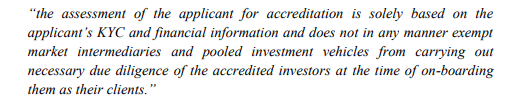
Accreditation Agencies shall grant Accredited Investor (AI) status solely on the basis of
(i). KYC Information - The applicant's Know Your Customer (KYC) information.
(ii). Financial Information
The applicant's relevant financial information required to determine whether the applicable AI eligibility criteria are satisfied.
The Accreditation Agency should therefore base its accreditation decision on the applicant's KYC and financial information.
10.1.7
To this effect, the accreditation certificate issued by accreditation agencies shall include the following disclaimer:
10.2. Eligibility Criteria for Accredited Investors
The following persons/entities are eligible to be considered Accredited Investors (AIs), subject to meeting the prescribed criteria.
(a). Individuals, HUFs, Family Trusts and Sole Proprietorships
These persons/entities can qualify by satisfying any one of the following criteria:
(i). Annual Income - Annual income must be ₹2 crore or more.
OR
(ii). Net Worth
Net worth must be ₹7.5 crore or more; and
At least ₹3.75 crore must be in the form of financial assets.
OR
(iii). Combination of Income and Net Worth
Annual income must be ₹1 crore or more; and
Net worth must be ₹5 crore or more; and
At least ₹2.5 crore of the net worth must be in financial assets.
(b). Partnership Firms
A Partnership Firm established under the Indian Partnership Act, 1932 can qualify as an AI.
However, each partner must independently satisfy the applicable accreditation criteria.
Therefore, if even one partner does not satisfy the criteria, the partnership firm would not qualify on this basis.
(c). Trusts Other Than Family Trusts
A Trust can qualify as AI if net worth greater than or equal to INR 50 Crore.
(d). Body Corporates
A Body Corporate can qualify as an AI if its net worth is ₹50 crore or more.
10.2.2
A foreign investor incorporated or established in a form other than those specified under Para 10.2.1 shall be subject to the eligibility criteria applicable to Body Corporates.
Accordingly, such foreign investors must have a net worth of at least ₹50 crore to qualify as an Accredited Investor (AI).
Example:
A foreign investor is established in a legal form not covered under Para 10.2.1.
Its net worth is ₹60 crore.
Since its net worth exceeds ₹50 crore, it satisfies the applicable Body Corporate criterion, subject to other applicable requirements.
10.2.3.
For accreditation of individual investors, HUFs and Sole Proprietorships, the value of the primary residence shall not be considered while calculating net worth.
For an individual, the primary residence of the individual shall be excluded from net worth calculation.
For an HUF, the primary residence of the Karta shall be excluded.
For a Sole Proprietorship, the primary residence of the Sole Proprietor shall be excluded.
Example:
An individual has total assets of ₹10 crore, including a primary residence worth ₹3 crore.
For calculating net worth for AI accreditation, the ₹3 crore value of the primary residence will be excluded.
Therefore, the primary residence will not contribute towards satisfying the prescribed net worth threshold.
10.2.4.
Where an investment is held jointly by more than one individual, the eligibility criteria for Accredited Investor (AI) status will depend on the relationship between the joint holders.
(a). Parent(s) and Child(ren)
Where the joint holders are parent(s) and child(ren), at least one of the joint holders must independently satisfy the prescribed AI eligibility criteria.
Example:
A parent and child jointly hold an investment.
The parent independently satisfies the AI criteria.
The child does not independently satisfy the criteria.
The joint investment can still qualify for AI eligibility because at least one joint holder satisfies the criteria independently.
(b). Spouses
Where the joint holders are spouses, their combined income and/or net worth may be considered for determining AI eligibility.
Example:
Husband and wife jointly hold an investment.
Their combined income and/or net worth satisfies the prescribed AI criteria.
The joint holding can therefore qualify for AI eligibility.
For determining whether a Body Corporate satisfies the eligibility criteria for Accredited Investor (AI) status, its net worth shall be calculated using the prescribed formula.
Net Worth = (Capital + Free Reserves) − (Accumulated Losses + Deferred Expenditure not written off)
Capital means the capital of the Body Corporate.
Free reserves are reserves that are freely available for distribution or general purposes.
Accumulated losses must be deducted while calculating net worth.
Deferred expenditure that has not yet been written off must also be deducted.
Example:
Capital = ₹30 crore
Free reserves = ₹35 crore
Accumulated losses = ₹10 crore
Deferred expenditure not written off = ₹2 crore
Net Worth = (₹30 crore + ₹35 crore) − (₹10 crore + ₹2 crore)
Net Worth = ₹65 crore − ₹12 crore
Net Worth = ₹53 crore
Since the net worth is ₹53 crore, the Body Corporate satisfies the ₹50 crore net worth requirement for AI eligibility.
10.2.6.
For determining the eligibility of a Trust as an Accredited Investor (AI), its net worth shall be calculated using the following formula:
Net Worth = Book value of all assets, other than intangible assets − Book value of total liabilities
The book value of all assets is considered, except for intangible assets.
The book value of total liabilities is then deducted from the value of the eligible assets.
Example:
Book value of all assets, excluding intangible assets = ₹70 crore
Book value of total liabilities = ₹15 crore
Net Worth = ₹70 crore − ₹15 crore
Net Worth = ₹55 crore
Since the Trust has a net worth of ₹55 crore, it satisfies the ₹50 crore net worth requirement for AI eligibility, subject to other applicable conditions.
10.2.7.
The eligibility of a foreign investor to qualify as an Accredited Investor (AI) shall be determined based on the Indian rupee equivalent of their applicable income and/or net worth.
So, where the AI eligibility criteria prescribe an income or net worth threshold in Indian rupees:
The foreign investor's corresponding income or net worth must be converted into INR for determining eligibility.
Example:
A foreign investor has income equivalent to ₹2.5 crore.
Since the applicable income threshold is ₹2 crore, the investor satisfies the income criterion, subject to other applicable requirements.
10.3. Procedure for Accreditation
10.3.1.
A person seeking to be recognised as an Accredited Investor (AI) must apply to an Accreditation Agency.
The application must be made in the manner and format specified by the Accreditation Agency.
The Applicant must submit the required documents for the accreditation process.
The detailed list of documents required for accreditation is provided in Annexure 11.
10.3.2.
The Accreditation Agency shall issue an Accreditation Certificate to an Applicant who is successfully accredited.
Each Accreditation Certificate must contain the following details:
(i). Unique accreditation number.
(ii). Name of the Accreditation Agency.
(iii). PAN of the Applicant.
(iv). Validity period of the accreditation, including Start date and End date.
Example:
Investor A successfully completes the accreditation process.
The Accreditation Agency issues an Accreditation Certificate containing:
Accreditation Number: Unique identification number.
Accreditation Agency: Name of the issuing agency.
PAN: PAN of Investor A.
Validity: Start date and end date.
10.4. Validity of Accreditation
10.4.1.
If the Applicant satisfies the prescribed AI eligibility criteria for the preceding financial year, the Accreditation Agency shall issue an Accreditation Certificate valid for 2 years.
The 2-year validity period will be calculated from the date of issuance of the Accreditation Certificate.
Example:
Investor A satisfies the AI eligibility criteria for the preceding financial year.
The Accreditation Agency issues the Accreditation Certificate on 1 September 2026.
The certificate will be valid for 2 years, i.e. until 31 August 2028.
10.4.2.
If the Applicant satisfies the prescribed AI eligibility criteria in each of the preceding two financial years, the Accreditation Certificate shall be valid for 3 years.
The 3-year validity period will be calculated from the date of issuance of the Accreditation Certificate.
Example:
Investor A satisfies the AI eligibility criteria for both of the preceding two financial years.
The Accreditation Agency issues the Accreditation Certificate on 1 September 2026.
The certificate will be valid for 3 years, i.e. until 31 August 2029.
10.4.3.
If the Applicant is a newly incorporated entity and does not have financial information for the preceding financial year, it can still apply for accreditation.
The entity must satisfy the applicable net worth criteria as on the date of application.
If the net worth criteria are satisfied, the Accreditation Certificate shall be valid for 2 years.
The 2-year validity period is calculated from the date of issuance of the Accreditation Certificate.
Example:
Company A is newly incorporated and therefore does not have financial information for the preceding financial year.
On the date of application, Company A has a net worth of ₹60 crore.
The applicable AI criterion is a net worth of ₹50 crore or more.
Company A satisfies the net worth requirement.
If the Accreditation Certificate is issued on 1 September 2026, it will be valid for 2 years, i.e. until 31 August 2028.
10.5. Procedure to avail benefits linked to accreditation
10.5.1.
Prospective investors who wish to avail benefits under the Accredited Investor (AI) framework must submit:
A copy of their Accreditation Certificate.
An undertaking to the investment service provider.
The undertaking must confirm the following:
(a). Consent to avail AI benefits
The prospective investor must expressly consent to avail the benefits available under the AI framework.
(b). Knowledge and understanding
The investor must confirm that they have the necessary knowledge and means to understand:
The features of the investment product/service available to AIs.
The risks associated with the investment.
(c). Awareness of regulatory oversight
The investor must acknowledge that investments made by AIs may not be subject to the same level of regulatory oversight as investments made by other investors.
(d).Ability to bear financial risks
The investor must confirm that they have the financial capacity to bear the risks associated with the investment.
Example:
Investor A wants to invest in an investment product available to AIs with a lower minimum investment requirement.
Investor A submits:
A valid Accreditation Certificate; and
An undertaking confirming that Investor A:
Consents to use the AI framework.
Understands the product and its risks.
Is aware of the potentially lower regulatory oversight.
Has the ability to bear the financial risks.
10.5.2.
The investment service provider must independently verify the Accredited Investor (AI) status of the prospective investor.
The verification must be carried out with the concerned Accreditation Agency.
The investment service provider cannot rely solely on the Accreditation Certificate submitted by the investor without independently verifying the accreditation status.
The investment service provider may also obtain additional undertakings from the prospective investor.
However, any additional undertaking must not:
Dilute the undertakings required under Para 10.5.1; or
Contravene or conflict with those undertakings.
Example:
Investor A submits an Accreditation Certificate to an investment service provider.
The service provider independently verifies Investor A's accreditation status with the concerned Accreditation Agency.
The service provider may also ask Investor A to provide an additional undertaking regarding understanding of a particular investment product.
However, the additional undertaking cannot remove or weaken the requirements specified under Para 10.5.1.
10.5.3.
Before entering into a client agreement with an Accredited Investor (AI)
The investment service provider must provide the AI with details of the relevant conditions and regulatory concessions applicable to the proposed investment.
The disclosure must explain the specific benefits, flexibilities or concessions available to the AI under the AI framework.
This disclosure must be made before the client agreement is entered into.
Example:
An AI proposes to invest in a product where AIs are permitted to invest at a lower minimum investment amount.
Before entering into the client agreement, the investment service provider must inform the AI about:
The applicable lower investment threshold.
The conditions attached to the concession.
Any other relevant regulatory concessions applicable to the investment.
10.5.4.
The client agreement between the investment service provider and the Accredited Investor (AI) must contain certain details relating to the AI framework.
(a). Regulatory concessions and conditions
The agreement must specify the regulatory concessions agreed upon between the investor and the investment service provider.
It must also specify the conditions that must be satisfied to avail those concessions.
Example:
An AI is permitted to invest at a lower minimum investment amount.
The client agreement must mention:
The lower investment amount applicable to the AI.
The conditions attached to availing that concession.
(b). Investor becoming ineligible as an AI
The agreement must specify the consequences if the investor ceases to qualify as an AI during the period of the agreement.
This ensures that both the investor and investment service provider know what happens if the investor loses AI status.
Example:
Investor A enters into a client agreement as an AI.
During the tenure of the agreement, Investor A no longer satisfies the AI eligibility criteria.
The agreement must specify what happens thereafter, such as whether the AI-specific regulatory concession will cease to apply.
10.5.5.
Pending receipt of the Accreditation Certificate, the Manager of an AIF may, based on its assessment of the investor's eligibility, finalise and execute the contribution agreement with the prospective investor.
The Manager may also initiate related operational procedures before the Accreditation Certificate is received.
However, this is subject to the following conditions:
(a). Commitment not included in corpus
Any commitment made by the prospective investor shall not be included in the corpus of the AIF scheme until the investor obtains the Accreditation Certificate.
This ensures that prudential norms based on the corpus of the AIF are not affected by an investor who has not yet been formally accredited.
Example:
AIF Scheme has a corpus of ₹50 crore.
Investor A commits ₹10 crore but has not yet received the Accreditation Certificate.
The ₹10 crore commitment cannot be counted towards the scheme's corpus until Investor A receives the certificate.
(b). Funds can be received only after accreditation
The AIF scheme may receive funds from the investor only after the investor obtains the Accreditation Certificate.
Therefore, signing the contribution agreement does not permit the AIF to actually receive the investor's contribution before accreditation.
Example:
Investor A signs a contribution agreement with the AIF before receiving the Accreditation Certificate.
The AIF may execute the agreement and complete related procedures.
However, the AIF cannot accept Investor A's funds until the Accreditation Certificate is obtained.
10.6. Flexibility to investors to withdraw ‘Consent’
10.6.1.
An Accredited Investor (AI) has the flexibility to withdraw its consent and discontinue the benefits available under the AI framework.
However, the consequences of withdrawing consent depend on the type of benefit previously availed.
(a). Withdrawal after availing Lower Ticket Size
If an AI withdraws consent after having invested using a lower ticket size:
The investor must increase its investment to the minimum investment amount prescribed under the applicable regulatory framework.
The increase must be made within the timeframe specified in the client agreement.
Example:
The normal minimum investment requirement for a product is ₹1 crore.
An AI invests ₹50 lakh by availing the lower ticket size benefit.
The investor subsequently withdraws its consent to the AI framework.
The investor must increase its investment from ₹50 lakh to the applicable minimum of ₹1 crore within the timeframe specified in the client agreement.
(b). Withdrawal after availing Regulatory Concessions
If an AI withdraws its consent after availing regulatory concessions, the investments already made will be grandfathered.
Grandfathering means that the investments already made will continue to be treated as AI investments, even after withdrawal of consent.
However, from the date of withdrawal of consent, any further transaction must comply with the regulatory framework applicable to non-AI investors.
Example:
Investor A makes an investment while enjoying an AI-specific regulatory concession.
Investor A withdraws consent before the client agreement expires.
The existing investment will continue to be treated as an AI investment.
Any new investment or further transaction after withdrawal must comply with the requirements applicable to non-AI investors.
10.6.2.
Investors in pooled investment products launched exclusively for Accredited Investors (AIs) cannot withdraw their consent once they have invested.
This applies where the pooled investment product has availed concessions from the applicable regulatory framework.
Therefore, the flexibility to withdraw consent under Para 10.6.1 does not apply to investors in such exclusively AI-only pooled products.
Example:
A pooled investment product is launched exclusively for AIs.
The product has availed specific regulatory concessions available under the AI framework.
Investor A invests in the product after consenting to the AI framework.
Investor A cannot subsequently withdraw the consent merely to discontinue the AI framework benefits.
10.6.3.
The client agreement between the investment service provider and the Accredited Investor (AI) must specify the procedure for withdrawal of consent.
It must also clearly state the consequences of withdrawing consent.
Therefore, the investor should know in advance:
How consent can be withdrawn.
What will happen after consent is withdrawn.
Example:
Investor A has entered into a client agreement with an investment service provider as an AI.
The agreement must specify the procedure for withdrawing consent, such as the manner in which the investor must communicate the withdrawal.
It must also specify the consequences, such as:
Loss of AI-specific regulatory concessions.
Requirement to comply with the regulatory framework applicable to non-AI investors.
