Acceptance of Deposits Rules (Part 1)
Rule 2: Definitions
(1). In these rules, unless the context otherwise requires:
(a).
Act means the Companies Act, 2013.
(b).
Annexure means the Annexure attached to these rules.
(c).
Deposit means any money received by a company whether as a deposit, loan, or in any other form.
However, certain types of receipts are not treated as deposits.
These exclusions are:
(i).
Any amount received from the following sources:
The Central Government.
A State Government.
Any other source, if the Central Government or State Government guarantees repayment of that amount.
A local authority.
A statutory authority created under an Act of Parliament or a State Legislature.
(ii).
Any amount received from the following foreign sources, provided it complies with the Foreign Exchange Management Act, 1999 (FEMA) and its rules and regulations:
Foreign Governments.
Foreign or international banks.
Multilateral financial institutions, such as:
International Finance Corporation (IFC).
Asian Development Bank (ADB).
Commonwealth Development Corporation (CDC).
International Bank for Industrial and Financial Reconstruction.
Foreign Government–owned development financial institutions.
Foreign export credit agencies.
Foreign collaborators.
Foreign bodies corporate (foreign companies).
Foreign citizens.
Foreign authorities.
Persons resident outside India
(iii).
Any amount received as a loan or financial facility from any of the following:
A banking company.
The State Bank of India (SBI).
Any subsidiary bank of SBI.
Any banking institution notified by the Central Government under section 51 of the Banking Regulation Act, 1949.
A corresponding new bank as defined in:
Section 2(d) of the Banking Companies (Acquisition and Transfer of Undertakings) Act, 1970.
Section 2(b) of the Banking Companies (Acquisition and Transfer of Undertakings) Act, 1980
A co-operative bank as defined in section 2(b-ii) of the Reserve Bank of India Act, 1934
(iv).
Any amount received as a loan or financial assistance from the following sources:
Public Financial Institutions (PFIs)
These must be notified by the Central Government, and such notification is made in consultation with the Reserve Bank of India (RBI).
Regional financial institutions
These are institutions operating at a regional level that provide financial assistance.
Insurance companies.
This includes LIC and any other insurance company providing loans or financial assistance.
Scheduled Banks, as defined in the Reserve Bank of India Act, 1934
These are banks included in the Second Schedule of the RBI Act.
(v).
Any amount received by an entity through:
Issue of commercial paper (CP).
Commercial paper is a short-term, unsecured debt instrument issued by companies to raise funds.
Any other financial instruments.
These instruments must be issued in accordance with the guidelines or notifications issued by the Reserve Bank of India (RBI).
(vi).
Any amount received by a company from any other company.
(vii).
Any amount received and held by a company as part of an offer made under the Act, specifically:
Subscription money for securities.
This includes money received from investors who apply to purchase shares, debentures, or other securities.
Share application money.
Money paid by applicants when applying for shares.
Advance towards allotment of securities.
Money given in anticipation of getting securities during an allotment process
The amount remains covered only as long as it is used solely for adjusting the amount due on allotment of the securities that were applied for.
Explanation:
(a).
If a company receives application money or advance money for securities (like shares or debentures), it must allot the securities within 60 days of receiving that money.
If the company cannot allot the securities within those 60 days, then it must refund the money within the next 15 days.
If the company fails to refund the money within those 15 days, then the amount will be treated as a deposit under these rules.
This is in addition to any other liability or action the company may face for the delay.
If a company had collected money for shares or securities before April 2014, and had not allotted them even by March 2015 then:
It had time only until June 1, 2015 to either:
Allot the securities.
Refund the money.
Follow the deposit rules.
(b).
Any adjustment of the amount for any other purpose shall not be treated as refund.
(viii).
Some companies had accepted or invited public deposits under the old law the Companies Act, 1956 and the rules made under it.
These are referred to as Earlier Deposits.
Such companies have been regularly repaying those earlier deposits and the interest as per the terms applicable under the old law.
In these cases, the law clarifies the following:
Section 74(1)(b) requires companies to repay deposits and interest within the specified time under the 2013 Act.
For companies with Earlier Deposits, this requirement is considered fulfilled (deemed compliance) if the company:
Follows the requirements of the Companies Act, 2013.
Follows the relevant Deposit Rules.
Continues to repay the Earlier Deposits and the interest strictly on their original due dates.
It has to do the above action in accordance to the original terms and conditions and original tenure of those deposits.
Any new deposits (fresh deposits) accepted by an eligible company must comply fully with:
Chapter V of the Companies Act, 2013.
the Companies (Acceptance of Deposits) Rules, 2014.
This means Earlier Deposits can continue as per old terms, but all new deposits must follow the new law.
(ix).
Money raised through bonds or debentures is not treated as a deposit if they are:
Secured by a first charge.
Secured by a charge pari passu with the first charge.
On any assets listed in Schedule III of the Companies Act (excluding intangible assets).
Bonds or debentures that are compulsorily convertible into shares of the company within five to ten years are also not treated as deposits.
If the bonds or debentures are secured by a charge on assets covered under Schedule III (excludes tangible assets) then:
The total amount of such bonds or debentures must not exceed the market value of those charged assets.
The market value of the charged assets must be assessed by a registered valuer.
Secured by First Charge
A first charge is the primary or top-priority security interest created over an asset.
The lender holding the first charge gets first right over the secured asset if the borrower defaults.
This lender is paid before all other lenders from the sale or enforcement of that asset.
Secured by a charge pari passu with the first charge
Pari passu means “Equal Footing” or equal ranking.
A charge pari passu with the first charge means:
Two or more lenders have equal ranking first charges over the same asset.
No lender has priority over another.
If the asset is sold, they share the proceeds proportionately to their outstanding amounts.
Example:
1.
ABC Ltd. issues secured debentures worth ₹50 lakh.
They create a first charge on their factory building.
If ABC defaults, the debenture holders have the first right to recover money from the sale of the factory.
Because the debentures are secured by a first charge, they are not considered deposits.
2.
ABC Ltd. already has a bank loan secured by a first charge on machinery.
Now it issues debentures and gives debenture holders a pari passu charge on the same machinery.
Both the bank and debenture holders rank equally on the machinery.
3.
Company LMN Ltd. has land valued at ₹2 crore, and this valuation has been carried out by a registered valuer.
The company proposes to issue secured debentures worth ₹3 crore using this land as security.
Since the proposed debenture amount exceeds the market value of the charged asset (₹3 crore > ₹2 crore) so:
Such an issue is not permitted and the debentures may be treated as deposits.
However, if LMN Ltd. issues secured debentures worth ₹1.5 crore, this amount is within the market value of the land (₹1.5 crore < ₹2 crore).
In that case, the debentures would not be treated as deposits, because the security adequately covers the issue as required under the Companies Act.
(ix a).
Any amount raised through non-convertible debentures (NCDs) is not treated as a deposit if certain conditions are met.
The NCDs must not create any charge on the assets of the company.
The NCDs must be listed on a recognised stock exchange.
The listing must comply with the regulations issued by SEBI (Securities and Exchange Board of India).
(x).
Money received from an employee is not treated as a deposit if certain conditions are met:
The amount received must not exceed the employee’s annual salary.
The amount must be taken under a contract of employment with the company.
It must be in the nature of a non-interest-bearing security deposit.
(xi).
Any amount that is non-interest bearing is not treated as a deposit if:
If it is received in trust.
If it is held in trust by the company.
The key requirement is that the money must be held as a trustee, not as a borrower.
(xii).
Any amount received in the course of business not a deposit if it is received as:
(a). Advance for supply of goods or services
An amount received as an advance for supplying goods or providing services.
It can be recorded in any manner in the books.
It must be adjusted (appropriated) against the supply of goods or services within 365 days of receiving the advance.
If the advance is involved in legal proceedings, the 365-day limit does not apply.
(b).Advance related to immovable property
An amount received as an advance for the sale of immovable property under any agreement or arrangement.
It must be adjusted against the property as per the terms of the agreement.
(c). Security deposit for contract performance
An amount received as a security deposit for ensuring performance of a contract for supply of goods or provision of services.
(d). Advance for long-term capital goods projects
An amount received as an advance under long-term projects for supplying capital goods.
(This excludes advances covered by clause (b).)
(e).Advance for future services (warranty/maintenance)
An advance received as consideration for future services, such as:
A warranty contract.
A maintenance contract.
There must be a written agreement.
The service period must not exceed the period normally followed in business practice or five years, whichever is shorter.
(f). Advance allowed by regulator or government
An advance received as permitted by a sectoral regulator or under directions of the Central or State Government.
(g). Advance for publication subscriptions
An advance received for subscription to any publication—printed or electronic.
It must be adjusted against the delivery of the publication.
If a company receives money under items: (The alphabets are in reference to the above provision)
(a). As advance for goods.
(b). Advance for property
(d). Advance for services
And later that money has to be refunded whether with interest or without interest because the company did not have the required permission or approval to deal in those goods, properties, or services, then that amount will be treated as a deposit under the Deposits Rules.
Example:
XYZ Ltd. takes ₹50 lakh as an advance from a customer to sell a specific type of chemical.
Later, it turns out XYZ Ltd. does not have the required government licence to trade in that chemical.
Since they cannot complete the sale, they must refund the advance.
Explanation:
Once the refund becomes due, a 15-day period starts.
If the company does not refund the amount within these 15 days,
Then the amount is automatically treated as a deposit under the rules.
(xiii).
An unsecured loan brought in by the promoters will not be treated as a deposit if all the following conditions are satisfied:
The loan is brought in because a lending bank or financial institution has specifically required the promoters to contribute such funds.
The money is provided only by the promoters themselves, or by their relatives, or by both.
The exemption is available only if the promoters bring in the amount as per the stipulated conditions laid down by the lending institution.
(xiv).
For the purposes of this clause, the following amounts will be treated as deposits, even if connected to a Nidhi:
(a)
Any amount received by the company from a person where:
The amount may be received in instalments or in any other manner.
The company has made a promise or offer to give returns.
Returns can be in cash or in kind.
The returns are to be given after a specified period or even earlier;
It does not matter how the amount is recorded in the books (i.e., accounting treatment does not change its nature).
Such amounts are treated as deposits.
(b)
Any additional contribution made by the company over and above the amount covered in item (a), and given as part of the same promise or offer, is also treated as a deposit.
(xv).
Any amount that a company receives as a subscription in a chit conducted under the Chit Fund Act, 1982 is not treated as a deposit.
Because contributions made by members towards a registered chit fund scheme are regulated separately under the Chit Fund Act.
(xvi).
Any amount a company receives under a Collective Investment Scheme (CIS) that is fully compliant with SEBI regulations is not treated as a deposit under the Companies Act.
Provided:
The company must be running a Collective Investment Scheme as defined and regulated by SEBI.
The scheme must follow all SEBI rules and regulations.
Money collected through such a SEBI-regulated CIS is excluded from the definition of deposits.
(xvii).
The company must receive ₹25,00,000 or more in a single tranche.
Only a start-up company (as recognised under relevant laws) can use this exemption.
The money must be received through a convertible note , which is a debt instrument that:
Converts into equity shares or it can be repaid with a period of 5 years from the date of issue.
Initially the period was 10 years.
The ₹25 lakh or more must be received from a single person.
If all these conditions are satisfied, the amount will NOT be treated as a deposit.
Explanation
For the purposes of this sub-clause:
A start-up company means a private company incorporated under either:
The Companies Act, 2013, or The Companies Act, 1956.
The company must also be officially recognised as a start-up under the notification G.S.R. 127(E) dated 19 February 2019.
This notification was issued by the Department for Promotion of Industry and Internal Trade (DPIIT).
Convertible Note
A convertible note is an instrument that shows the company has received money initially as a debt.
This debt may later:
Be repaid to the holder (at the holder’s option).
Be converted into equity shares of the start-up company.
The conversion happens when specified events occur and must follow the terms and conditions stated in the convertible note.
(xviii).
Any amount a company receives from certain SEBI-registered investment vehicles is not treated as a deposit, provided these entities are registered under SEBI regulations.
The exemption applies when a company receives money from any of the following SEBI-regulated entities:
Alternate Investment Funds (AIFs).
Domestic Venture Capital Funds.
Infrastructure Investment Trusts (InvITs)
Real Estate Investment Trusts (REITs)
Mutual Funds
All these entities must be registered with SEBI under the relevant regulations.
Since these entities are already under strict SEBI supervision, the money they invest in a company is not treated as a deposit under the Companies (Acceptance of Deposits) Rules.
(d).
Depositor means:
(i).
A member (shareholder) of a company who has made a deposit with the company,
The deposit should be in accordance with Section 73(2) of the Companies Act (Deposits accepted from members only, with prescribed conditions).
(ii).
Any person (not necessarily a member) who has made a deposit with a public company.
The deposit should be made in accordance with Section 76 of the Companies Act. (Deposits accepted from the public by eligible public companies).
(e).
Eligible company means a public company that satisfies ALL the following conditions:
It must be a public company covered under Section 76(1) of the Companies Act.
A public company allowed to accept deposits from the public under prescribed conditions).
It must have either:
A net worth of at least ₹100 crore.
A turnover of at least ₹500 crore.
It must obtain prior approval of shareholders:
This approval must be taken in a general meeting.
The approval must be through a special resolution.
The special resolution must be filed with the Registrar of Companies (RoC) before inviting the public to deposit money.
(f).
The term fees refers to the fees prescribed under the Companies (Registration Offices and Fees) Rules, 2014.
So , whenever the Companies Act or its rules mention fees they are talking about the charges laid down in these specific rules for various filings etc.
(g).
A Form or e-Form refers to the specific form that is provided in the Annexure to these rules.
That form must be used for the particular purpose or matter it is designed for.
(h).
Section means the section of the Act.
(i).
The term trustee has the same meaning as given in Section 3 of the Indian Trusts Act, 1882.
A trustee is the person who holds property for the benefit of another person (called the beneficiary) under the terms of a trust.
They are responsible for managing the trust property honestly, carefully, and according to the trust document.
(2).
If any word or expression appears in these rules but is not defined here, then:
If that word is defined in the Companies Act.
Or defined in the Reserve Bank of India Act, 1934.
Or defined in the Companies (Specification of Definitions Details) Rules, 2014.
It will carry the same meaning as given in those Acts or rules.
Rule 3. Terms and conditions of acceptance of deposits by companies.
(1).
On and from the commencement of these rules:
(a).
With respect to Companies accepting deposits from members under Section 73(2), and Eligible companies accepting deposits from the public under Section 76.:
Such companies cannot accept or renew any deposit (secured or unsecured) if:
It is repayable on demand.
Repayable on notice of less than 6 months.
Repayable after more than 36 months from the date of acceptance or renewal.
Deposits must have a minimum tenure of 6 months and a maximum of 36 months, unless the proviso applies.
A company may accept short-term deposits (less than 6 months) only for meeting short-term fund requirements, but must meet both conditions below:
(a).
The total of such short-term deposits must not exceed 10% of:
Paid-up share capital
Free reserves
Securities premium account
These 3 categories together would be the aggregate.
(b).
These short-term deposits must be repayable not earlier than 3 months from the date of acceptance or renewal.
Minimum tenure for short-term deposits is 3 months
Maximum tenure for short-term deposits less than 6 months
(2).
A company may accept deposits in joint names if the depositors request it.
The number of joint depositors cannot exceed three persons.
The deposit can be opened with or without any of the following operational clauses:
Jointly - All depositors must act together for any transaction.
Either or Survivor - Any one depositor can operate the deposit; after one dies, the survivor can operate it.
First named or Survivor - Only the first person named can operate it & after their death, the survivor(s) can operate it.
Anyone or Survivor - Any one of the depositors can operate it; if one dies, the remaining survivor(s) can operate it.
(3).
Companies accepting deposits from members under Section 73(2).
A company cannot accept or renew any deposit from its members if:
The new deposit amount.
The existing outstanding deposits exceed 35% of the aggregate of:
Paid-up share capital
Free reserves
Securities premium account
(Note: Earlier the limit was 25%, now increased to 35%.)
A private company may accept deposits from its members up to 100% of:
Paid-up share capital
Free reserves
Securities premium account
The company must file details of the money accepted with the Registrar in the manner specified.
For Specified IFSC Public Companies and Private Companies
A Specified IFSC Public Company and a Private Company may accept deposits from members up to 100% of:
Paid-up share capital
Free reserves
Securities premium account.
Such companies must file the details with the Registrar in Form DPT-3.
To Access Form DPT - 3: https://ca2013.com/wp-content/uploads/2019/01/form-dpt-3.pdf
Explanation.
A Specified IFSC Public Company is an unlisted public company that:
Is licensed to operate by RBI or SEBI or IRDAI.
Operates from an International Financial Services Centre (IFSC).
Is located in an approved multi-services SEZ.
Is set up under the SEZ Act 2005 and SEZ Rules 2006.
Private Companies Exempt from the Maximum Deposit Limit
The limit on deposits from members does not apply to the following private companies:
(i).
A private company that is recognised as a start-up.
Exemption applies for 5 years from the date of incorporation
(ii).
Other eligible private companies that meet all conditions below:
The company is not an associate company or a subsidiary of any other company.
Borrowings from banks or financial institutions or any body corporate are less than the lower of:
Twice its paid up share capital or fifty crore rupees.
The company has not defaulted in repaying any of its borrowings that are outstanding when it accepts deposits under section 73.
All companies that accept deposits must file the details of money accepted with the Registrar in Form DPT-3.
(4).
(a).
A company is restricted from accepting or renewing deposits from its members in certain cases.
To check this, the company must add:
1. The amount of the new deposit being accepted or renewed.
2. the amount of all deposits already outstanding on that date.
After adding these two amounts, the company must compare the total with 10% of the following:
Paid up share capital.
Free reserves.
Securities premium account
If the combined deposit total is more than 10% of the above three items, the company cannot accept or renew the deposit.
Example:
Consider a company, ABC Pvt Ltd.
It has the following financial components:
Paid-up share capital: ₹50 crore.
Free reserves: ₹20 crore.
Securities premium account: ₹10 crore
First, we must calculate the maximum limit up to which the company can accept deposits from its members.
To do this, we add the three figures: 50 + 20 + 10 = ₹80 crore.
According to the rule, the company can accept deposits only up to 10% of this amount.
So, 10% of ₹80 crore = ₹8 crore.
So the company’s total deposits from members, existing plus new, cannot exceed ₹8 crore.
Suppose the company already has ₹6 crore in member deposits outstanding.
A member now wants to give a fresh deposit of ₹3 crore.
We must check if accepting this deposit would cross the limit.
Existing deposits: ₹6 crore
New proposed deposit: ₹3 crore
Combined total: ₹9 crore
Since ₹9 crore is more than the allowed limit of ₹8 crore, the company cannot accept or renew this deposit. Doing so would violate the rule.
(b).
This rule applies to any deposit other than the type of deposit referred to in clause (a).
These deposits are from other than members of the company.
The company must calculate:
The amount of the new deposit it wants to accept or renew &
The amount of other deposits already outstanding on that date (excluding deposits under clause (a)).
The company cannot accept or renew the new deposit if the total of these amounts is more than 25% of the following:
Paid-up share capital.
Free reserves
Example:
The company has the following financial figures:
Paid-up share capital: ₹40 crore
Free reserves: ₹20 crore
To determine the maximum deposit limit permitted under this rule, we first add these two components: 40 crore + 20 crore = ₹60 crore
According to the rule, the company can accept or renew deposits (other than deposits referred to in clause (a)) only up to 25% of this amount.
25% of ₹60 crore would be ₹15 crore.
So , XYZ Ltd is allowed to have a maximum of ₹15 crore of deposits under this particular category.
(5).
A Government company that is allowed to accept deposits from the public under section 76 must follow a strict limit.
Such a company cannot accept or renew a deposit if the following total to exceed the permitted ceiling:
The amount of the new deposit being accepted or renewed + The amount of all other deposits already outstanding on that date.
This combined total must not exceed 35% of the sum of:
Paid-up share capital.
Free reserves.
Securities premium account.
(6).
The rule applies to companies taking deposits from members under section 73(2) and eligible companies taking public deposits under section 76.
These companies must follow limits on the interest they offer and the brokerage they pay.
They cannot invite, accept or renew any deposit if the interest rate they offer is higher than the maximum rate allowed by RBI for NBFCs.
They also cannot pay brokerage at a rate higher than what RBI permits NBFCs to pay.
Explanation
For this sub-rule, the following applies:
A company may authorise a person in writing to Solicit / Request / Procure deposits on its behalf.
Only this authorised person is allowed to receive brokerage for bringing in deposits.
If the company pays brokerage to any other person who is not the authorised person then that payment will be considered a violation of the rules.
(7).
Once a company issues its circular or advertisement inviting deposits, and starts accepting deposits, then:
It cannot keep any right (directly or indirectly) to change the terms in a way that harms the depositor.
This restriction applies to:
The terms and conditions of the deposit.
The deposit trust deed.
The deposit insurance contract.
(8). Omitted.
(8a).
Every eligible company must obtain a credit rating for the deposits it has accepted.
Eligible company allowed to accept deposits from the public under section 76.
This credit rating must be obtained at least once every year.
A copy of the latest credit rating must be submitted to the Registrar of Companies (RoC).
The rating must be sent along with the company’s annual return of deposits, which is filed in Form DPT-3.
(8b).
The credit rating that an eligible company obtains for its deposits must meet a minimum standard.
The rating cannot be below:
The minimum investment-grade rating, or any other specified credit rating for fixed deposits, as prescribed for NBFCs.
The company must obtain the credit rating from an agency that is approved by RBI.
These are the same credit rating agencies that are authorised to rate fixed deposits of NBFCs.
The rating must meet the standards laid down in the NBFC Acceptance of Public Deposits Directions, 1998.
These RBI directions may be revised occasionally, and the company must follow the updated standards.
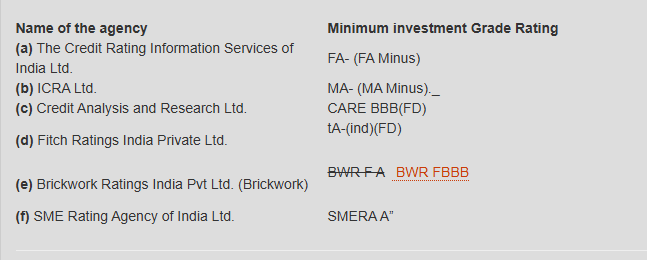
Credit rating agencies approved for rating fixed deposits of NBFCs, along with the minimum required investment-grade rating for each agency.
