Private Placement Memorandum
Chapter 2 - Filing of PPM for launch of AIF scheme
2.1 - Template(s) for PPM
2.1.1
Private Placement Memorandum (PPM) is the primary document containing important information about the AIF.
The PPM is provided to prospective investors so that they can understand the AIF before making an investment.
The PPM contains the necessary information about the AIF, including details relevant to the proposed investment.
SEBI has prescribed a standardised PPM template to ensure a minimum level of disclosure.
The purpose of the template is to ensure that investors receive a minimum standard of information.
The prescribed format also makes the information simple and comparable across different AIFs.
The PPM template specifies the minimum information that must be disclosed.
AIFs are also permitted to provide additional information in their PPM beyond the minimum information required under the prescribed template.
2.1.2
The PPM template is divided into two parts:
Part A: Minimum Disclosures
Contains the minimum information that every AIF is required to disclose in its PPM.
Ensures that a standardised level of information is available to prospective investors.
The AIF must provide the disclosures prescribed under this part.
Part B: Supplementary Section
Provides flexibility to the AIF to include additional information.
The AIF may disclose any additional details or information that it considers relevant or appropriate for investors.
The information in Part B is supplementary to the mandatory disclosures in Part A.
2.1.3
The PPM template differs based on the category of the AIF.
For AIFs raising funds under Category I and Category II, the prescribed PPM template is provided in Annexure 1.
For AIFs raising funds under Category III, the prescribed PPM template is provided in Annexure 2.
2.1.4
The requirement to follow the SEBI-prescribed PPM template for filing the PPM with SEBI does not apply to the following:
(i). Angel Funds
Angel Funds, as defined under the AIF Regulations, are exempt from following the prescribed PPM template.
(ii). AIFs/Schemes with minimum ₹70 crore commitment per investor
This exemption applies where each investor commits a minimum capital contribution of ₹70 crore.
For commitments made in a non-INR currency, the equivalent of USD 10 million or the equivalent amount in that currency may be considered.
The investor must also provide a waiver to the fund from the requirement to use the SEBI-specified PPM template.
The waiver must be provided in the manner prescribed in Annexure 3.
Therefore, both conditions must be satisfied:
Minimum commitment of ₹70 crore per investor; and
Waiver from the investor agreeing that the prescribed PPM template need not be followed.
(iii). Large Value Funds for Accredited Investors
Large Value Funds for Accredited Investors (LVF), as defined under the AIF Regulations, are also exempt from following the prescribed PPM template.
Unlike the above category, no specific waiver from individual investors is required.
2.2. Disclosure of distribution waterfall and disciplinary history in PPM
2.2.1.
Every AIF must include a detailed example of the fees and charges applicable to investors in its Private Placement Memorandum (PPM).
The example must be presented in a tabular format.
The table should clearly show the different fees and charges that may be borne by the investor.
The PPM must also provide an example of the distribution waterfall.
A distribution waterfall explains how the money generated by the AIF is distributed among the investors and other parties, according to the agreed terms.
The example should therefore help investors understand:
What fees and charges they may have to pay;
How those charges affect their returns; and
How distributions are allocated under the waterfall mechanism.
2.2.2
Regulation 11(2) of the AIF Regulations requires an AIF to disclose its history of disciplinary actions in its PPM.
Accordingly, every AIF must include the disciplinary history of the following persons/entities in its PPM:
(i). AIF, Sponsor, Manager and their associated persons
The AIF itself.
The Sponsor of the AIF.
The Manager of the AIF.
Their directors.
Their partners.
Their promoters.
Their associates.
(ii). Where the applicant is a Trust
The trustees of the trust.
The trustee company, if applicable.
The directors of the trustee company.
The disciplinary history disclosed in the PPM must cover various types of legal, financial and regulatory matters.
(a). Details of legal, financial and compliance matters
Outstanding or pending cases of litigation.
Past cases where the person has been found guilty.
Criminal or civil prosecutions.
Disputes involving the relevant person/entity.
Non-payment of statutory dues.
Overdues or defaults to banks or financial institutions.
Contingent liabilities that have not been provided for.
Proceedings initiated for economic offences or civil offences.
Adverse findings relating to compliance with securities laws.
Penalties imposed by relevant authorities.
Disputed tax liabilities.
Other similar legal, financial or regulatory matters.
(b). Disciplinary action by regulators
Details of any disciplinary action taken by SEBI.
Details of any disciplinary action taken by any other regulatory authority.
HEADING
Operational actions such as administrative warnings or deficiency letters must also be considered while disclosing disciplinary history.
Such operational actions do not need to be listed individually in the PPM.
They may be grouped together and presented in a summarized form.
The summary should provide investors with an overall picture of such operational actions.
If an investor wants specific details of any matter included in the summary, the AIF must provide those details to the investor.
HEADING
Any new litigation, cases or similar matters that arise during the course of the AIF's activities must be appropriately dealt with.
Such matters must be incorporated into the PPM.
The AIF must also intimate its investors about such new litigation, cases or other relevant matters.
This means the disclosure requirement is ongoing and is not limited only to matters existing at the time the PPM is initially prepared.
2.2.3.
The disclosure of disciplinary history referred to in Para 2.2.2 shall cover the last 5 years.
Where a monetary penalty is involved, the disclosure requirement applies only where the penalty is greater than ₹5 lakh.
Therefore, monetary penalties of ₹5 lakh or less do not need to be covered under this specific disclosure requirement.
In case of disputed tax liabilities, the requirement does not apply to tax liabilities incurred in the personal capacity of an individual.
Therefore, only relevant disputed tax liabilities of the concerned entity/business need to be considered.
Contingent liabilities must be disclosed based on the books of accounts of the relevant entity.
The disclosure should therefore reflect the contingent liabilities as recorded in the entity's books of accounts.
2.3. Disclosure of Investor Charter and Investor complaints in PPM
SEBI has prepared an Investor Charter for AIFs.
The purpose of the Investor Charter is to provide investors with relevant information about various activities relating to AIFs.
It is intended to help investors better understand the AIF framework and their dealings with AIFs.
The Investor Charter provides information that is relevant to investors regarding the functioning and activities of AIFs.
2.3.1 .
The Investor Charter is a brief and concise document prepared for the benefit of AIF investors.
It brings important investor-related information together at one single place.
The Investor Charter contains details regarding:
Services provided to investors.
Grievance redressal mechanism available to investors.
Responsibilities of investors.
Other relevant information useful to investors.
The information is presented in lucid and simple language.
This makes the Investor Charter easy for investors to understand and refer to.
The objective is to provide investors with a clear and convenient reference document covering important aspects of their relationship with the AIF.
2.3.2.
All AIFs are required to take necessary steps to make the Investor Charter available to their investors.
The Investor Charter must be in the format prescribed under Annexure 4.
AIFs must bring the Investor Charter to the notice of their investors.
This must be done by disclosing the Investor Charter in the PPM.
Therefore, the PPM must contain the Investor Charter as prescribed in Annexure 4.
2.3.3.
All AIFs must provide additional disclosure regarding investor complaints to improve transparency in the Investor Grievance Redressal Mechanism.
AIFs must disclose details of investor complaints received against:
The AIF.
Each scheme of the AIF.
The AIF must also disclose the redressal status of these investor complaints.
This information must be disclosed in the format prescribed under Annexure 5.
The disclosure must be included as a separate chapter in the PPM.
Therefore, the PPM must provide investors with a clear view of:
The complaints received;
The scheme to which the complaints relate; and
The status of resolution/redressal of those complaints.
2.3.4.
AIFs must maintain data on investor complaints for effective monitoring of investor grievances.
The complaint data must be maintained in the format prescribed under Annexure 5.
The data should cover the relevant details of investor complaints received and their redressal status.
The complaint data must be compiled within 7 days from the end of each quarter.
2.3.5 .
These disclosure requirements are additional requirements.
They do not replace or override the existing requirements relating to the investor grievance handling mechanism.
AIFs must continue to comply with all applicable requirements under:
SEBI Regulations.
SEBI circulars.
SEBI directions.
So, compliance with the disclosure requirements under this framework is in addition to compliance with the existing investor grievance requirements.
An AIF must satisfy both the existing requirements and these additional disclosure requirements.
2.4. Modalities for filing of PPM and launch of Regular schemes
2.4.1.
Under Regulation 12 of the AIF Regulations, an AIF may launch one or more schemes.
Before launching a scheme, the AIF is required to file its Private Placement Memorandum (PPM) with SEBI.
The PPM must be filed with SEBI through a Merchant Banker registered with SEBI.
The requirement of filing the PPM through a SEBI-registered Merchant Banker applies before the launch of the scheme.
The following requirements are specifically prescribed in relation to Regular Schemes.
2.4.1.1.
An AIF can proceed with the launch of a new scheme after 10 working days from the date of filing the application with SEBI.
However, this is subject to SEBI not giving any contrary advice or direction during this period.
For the first scheme of an AIF, a slightly different condition applies.
The first scheme can be launched only from the later of:
The date on which SEBI grants registration to the AIF; or
10 working days after filing the application with SEBI.
Therefore, for the first scheme, the AIF must satisfy both the registration requirement and the 10-working-day period.
Example:
SEBI registration is granted on 1 August.
10 working days from filing expire on 5 August.
The first scheme can be launched only from 5 August, since it is the later date.
If SEBI registration is granted on 10 August, while the 10-working-day period ends on 5 August, the first scheme can be launched only from 10 August.
2.4.1.2.
The PPM of a Regular Scheme must be filed on the SEBI Intermediary Portal:
At the time of AIF registration or
Before launching a new scheme.
The PPM must be filed along with the applicable scheme fee.
In addition to the PPM and applicable fee, the following documents must be submitted:
(i). Merchant Banker Due Diligence Certificate
A duly signed Merchant Banker Due Diligence Certificate must be submitted.
It must be in the format prescribed under Annexure 6.
(ii). Fit and Proper Declarations
Duly signed Fit and Proper declarations must be submitted in respect of:
AIF.
Sponsor.
Manager of the AIF.
The declarations must be in accordance with Schedule II of the SEBI (Intermediaries) Regulations, 2008.
(iii). Minimum Continuing Interest Declarations
The Sponsor/Manager must provide declarations regarding their commitment to maintain the minimum continuing interest in the AIF or the Scheme.
(iv). PAN Details
Copies of PANs must be submitted for:
AIF.
Its scheme, if PAN is available/
Sponsor , Manager &Trustee.
Directors/partners of the Sponsor;
Directors/partners of the Manager;
Directors/partners of the Trustee; and
Members of the key investment team.
An Excel, Word or PDF file containing the names and PANs of the relevant entities and individuals must also be submitted.
2.4.1.3.
The Merchant Banker appointed for filing the PPM must conduct an independent due diligence of all disclosures contained in the PPM.
The Merchant Banker must independently verify the veracity of the disclosures, meaning it must satisfy itself that the information provided is true and accurate.
The Merchant Banker must also assess the adequacy of the disclosures, meaning it must ensure that the PPM contains sufficient information as required.
After completing its due diligence, the Merchant Banker must provide a Due Diligence Certificate.
The Merchant Banker therefore has an independent responsibility to verify the accuracy, completeness and adequacy of the information disclosed in the PPM.
The Merchant Banker appointed for filing the PPM cannot be an associate of:
The AIF.
The Sponsor.
The Manager.
The Trustee.
2.4.1.4.
The details of the Merchant Banker shall be disclosed in the PPM.
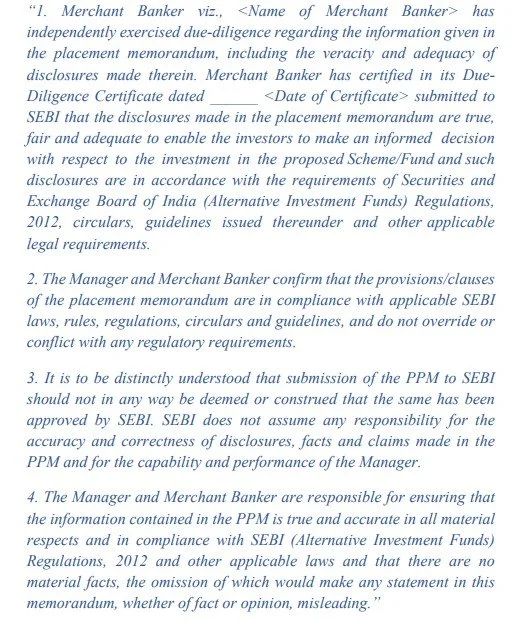
The following disclaimer clause shall be included in the PPMs of all Regular schemes:
2.4.1.5.
The Merchant Banker and the Manager of the AIF are responsible for ensuring the accuracy and completeness of all disclosures made in the PPM.
This responsibility applies to the PPMs of Regular Schemes.
They must ensure that the information disclosed in the PPM is:
Accurate.
Complete.
Properly disclosed as required.
The Merchant Banker and Manager are also responsible for the accuracy and completeness of the declarations submitted by them.
If there is any irregularity or lapse in the PPM, the concerned entities may be held liable for appropriate action.
Therefore, responsibility for the PPM does not rest solely with the AIF.
Both the Merchant Banker and Manager have responsibility for ensuring the quality and correctness of the disclosures.
Any misstatement, omission, irregularity or deficiency in the PPM may result in action against the concerned entities.
2.5. Modalities for filing of PPM and launch of schemes of AI only Funds, LVFs and Angel Funds
2.5.1.
SEBI introduced a framework for “Accredited Investors (AI)” in the securities market.
Following this framework, the AIF Regulations were amended to provide certain regulatory relaxations.
These relaxations are available to two types of AIF schemes:
(i). AIF schemes meant exclusively for Accredited Investors
These are commonly referred to as “AI only funds”.
The scheme can accept investments only from Accredited Investors.
Such schemes are eligible for certain relaxations from the regulatory requirements applicable to other AIFs.
(ii). Large Value Fund for Accredited Investors (LVF)
An LVF is an AI only fund.
It is a fund where each investor invests at least ₹25 crore.
LVFs are also eligible for certain regulatory relaxations under the AIF Regulations.
Therefore, the framework provides relaxations to:
AI only funds, where all investors are Accredited Investors; and
LVFs, which are AI only funds with a minimum investment of ₹25 crore from each investor.
2.5.2
The following requirements apply to the launch of schemes of:
AI only Funds.
Large Value Funds for Accredited Investors (LVFs).
Angel Funds.
The specific requirements for launching schemes of these funds are set out separately.
2.5.2.1 AI and LVF
2.5.2.1.1
Pursuant to the amendment of the AIF Regulations through the SEBI (AIF) (Second Amendment) Regulations, 2026:
Angel Funds are exempt from filing their Private Placement Memorandum (PPM) with SEBI through a Merchant Banker.
So , an Angel Fund is not required to appoint a Merchant Banker specifically for the purpose of filing its PPM with SEBI.
Angel Funds are also exempt from the requirement of incorporating SEBI's comments in their PPM.
Accordingly, SEBI's comments on the PPM, if any, do not have to be incorporated before the Angel Fund launches its scheme.
2.5.2.2. Angel Funds
2.5.2.2.1.
Under the proviso to Regulation 12(3A) of the AIF Regulations, certain relaxations are provided to AI only Funds and LVFs.
AI only Funds and LVFs are exempt from filing their PPM with SEBI through a Merchant Banker.
They are also not required to incorporate SEBI's comments in their PPM.
Therefore, they can launch their scheme immediately after filing the PPM with SEBI.
However, a separate requirement applies to the first scheme of an AI only Fund or LVF.
The first scheme can be launched only from the date of grant of SEBI registration.
2.5.2.2.2.
Accordingly, Angel Funds can proceed with circulation of their PPM to investors after receiving SEBI registration.
From the date of grant of SEBI registration:
The Angel Fund can circulate its PPM to prospective investors.
The PPM can be used for soliciting or raising funds from investors.
The Angel Fund does not need to wait for SEBI's comments on the PPM, since the applicable relaxation removes that requirement.
2.5.2.3.
The PPM of AI only Funds, LVFs and Angel Funds must be filed on the SEBI Intermediary Portal.
The applicable scheme fee or registration fee must also be paid, as applicable.
Along with the PPM and applicable fee, a duly signed and stamped undertaking must be submitted.
The undertaking must be given by:
The Chief Executive Officer (CEO) of the Manager of the AIF; or
A person holding an equivalent role or position, depending on the legal structure of the Manager; and
The Compliance Officer of the Manager of the AIF.
The undertaking must be in the format prescribed under Annexure 7.
Therefore, the filing requirements include:
PPM.
Applicable scheme/registration fee.
Signed and stamped undertaking under Annexure 7 from the CEO/equivalent person and Compliance Officer of the Manager.
2.5.2.4.
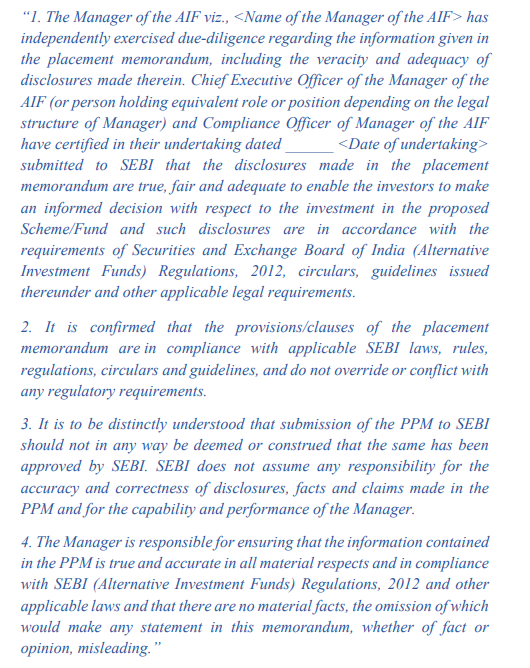
The following disclaimer clause shall be included in the PPMs of all AI only funds, LVFs and Angel Funds:
2.5.2.5
The Manager of the AIF is responsible for ensuring the accuracy and completeness of all disclosures made in the PPM.
The Manager must ensure that the information provided in the PPM is:
Accurate.
Complete.
Properly disclosed.
The Manager is also responsible for ensuring the accuracy and completeness of the declarations submitted by it.
If there is any irregularity or lapse in the PPM, the concerned entities may be held liable for appropriate action.
2.5.2.6.
Any new scheme proposed to be launched as an AI only scheme must include specific words in its scheme name.
The words “AI only fund” or “AIOF” must be added at the end of the scheme name.
This requirement makes it clear that the scheme is intended to be an AI only fund.
Examples:
“Xyz AI only fund”
“Xyz AIOF”
The words must appear at the end of the name, rather than merely being mentioned elsewhere in the scheme documents.
2.5.2.7. Any new scheme proposed to be launched as an LVF shall have the word ‘LVF’ added to the scheme name at the end (For example, ‘Abc LVF’).
2.6. Modalities for conversion into AI only schemes
Under Regulation 2(1)(ac) and Regulation 2(1)(pa) of the AIF Regulations, an existing AIF or scheme of an AIF may be permitted to convert into:
An AI only scheme.
An LVF scheme.
The conversion is subject to the conditions specified by SEBI.
Therefore, an existing AIF or scheme does not automatically become an AI only scheme or LVF scheme merely because it proposes to change its investor base.
The AIF must comply with the conditions and requirements prescribed by SEBI for such conversion.
2.6.1.
Existing eligible AIFs/Schemes of AIFs may convert or migrate to AI only schemes or LVF schemes.
Such conversion is permitted only if:
Positive consent is obtained from all investors.
The AIF/Scheme meets the respective conditions applicable to an AI only scheme or LVF scheme.
Upon conversion, the Manager of the AIF shall ensure the following:
(a). Change in name of the scheme
The name of the converted scheme must be changed to reflect its new status.
The name must incorporate:
AI only fund.
AIOF.
LVF, as applicable.
(b). Reporting to SEBI
The conversion and the resulting change in name of the scheme must be reported to SEBI.
The report must be sent by email to aifreporting@sebi.gov.in.
The reporting must be completed within 15 days of the conversion.
(c). Reporting to depositories
The change in the scheme's name must also be reported to the depositories.
This is required so that the depositories can make the necessary changes in their systems.
The reporting must be completed within 15 days of the conversion.
2.6.2.
If an investor qualifies as an Accredited Investor (AI) at the time of onboarding into an AIF scheme, that investor will continue to be treated as an AI for the entire life of the scheme.
The investor's AI status is therefore determined at the time of onboarding.
If the investor subsequently loses their AI status during the life of the scheme, they will still continue to be treated as an AI for that scheme.
2.6.3.
Under Regulation 13(5) of the AIF Regulations, the maximum permissible extension of the tenure of an AI only scheme is 5 years.
The 5-year limit is inclusive of any tenure extension that was granted before the scheme was converted into an AI only scheme or LVF scheme.
Therefore, the scheme cannot receive a fresh 5-year extension after conversion if some portion of the 5-year extension had already been used before conversion.
Example:
A scheme receives a 2-year extension before converting into an AI only scheme
After conversion, it can receive a maximum further extension of 3 years
The total extension cannot exceed 5 years.
The same principle applies where the scheme is converted into an LVF scheme.
2.7. Explanation
For the purposes of Para 2.4 to Para 2.6, the following terms have the specified meanings:
Regular Schemes
Regular Schemes means schemes other than:
Large Value Fund for Accredited Investors (LVF).
Accredited Investor Only Fund (AI only Fund).
Angel Funds.
Launch of a Scheme or Fund
Launch means the circulation of the Private Placement Memorandum (PPM) to investors.
The purpose of such circulation must be to solicit funds from investors.
Therefore, for these requirements, a scheme is considered launched when its PPM is circulated to investors for raising funds.
Working Days
Working days means all days except:
Saturdays.
Sundays.
Public holidays on which the concerned SEBI Office is closed for business.
The relevant public holidays are those published on the SEBI website.
