Procedure for Reduction of Share Capital
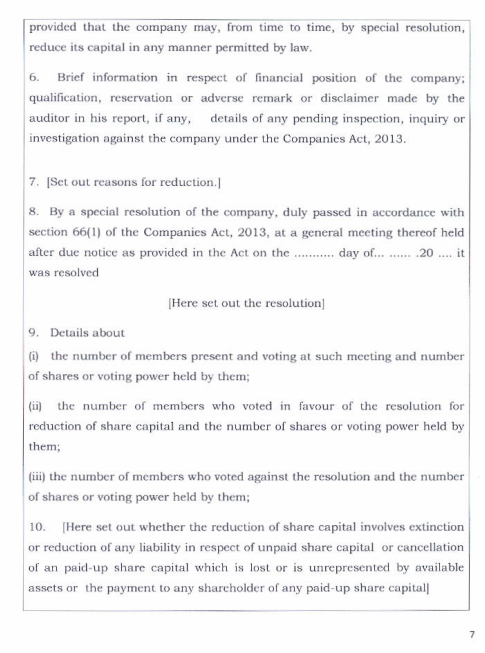
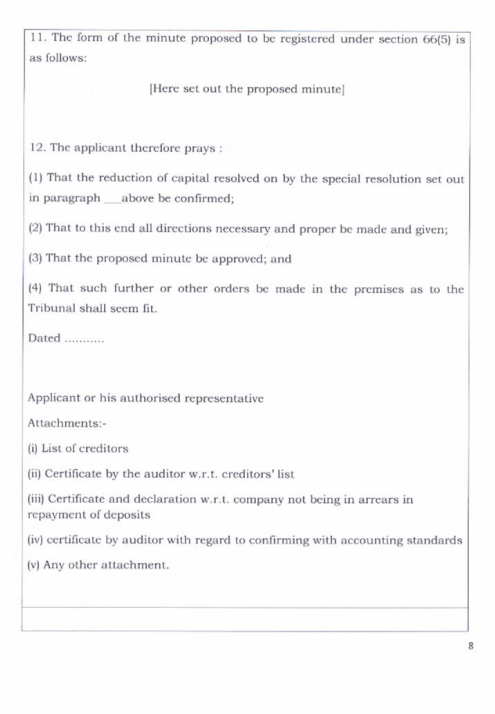
Rule 2. Form of application or petition for Reduction of share capital under section 66.
(1).
When a company wants to reduce its share capital it must take approval from the Tribunal (NCLT).
To obtain this approval, the company must:
File an application with the Tribunal.
Use the prescribed form, which is Form No. RCS-1.
Pay the required fee, which is specified in the Schedule of Fees under these rules.
(2).
When a company applies to the Tribunal (NCLT) for approval of capital reduction, the application must include the following documents:
(a). List of creditors (certified by management)
The company must attach a complete list of all its creditors, which must:
Be certified as true and correct by the Managing Director,
If there is no MD, then by two directors.
Be prepared not earlier than 15 days before the date of filing the application.
Show details for each creditor, including:
Name
Address
Amount owed
Classification (e.g., secured, unsecured, debenture holders, etc.)
(b). Auditor’s certificate confirming the creditor list
The application must include a certificate from the company’s auditor stating that:
The list of creditors submitted under clause (a) is correct, based on the company’s records and has been verified by the auditor.
(c). Certificate + Director’s declaration regarding deposits
Two confirmations are required:
Auditor’s certificate, and Declaration by a director, stating that:
The company is not in arrears in repayment of any deposits, or
Not in arrears on interest payable on such deposits as on the date of filing the application.
(d). Auditor’s certificate on accounting treatment
Another certificate from the auditor must confirm that:
The accounting treatment proposed for the capital reduction complies with the accounting standards under Section 133 of the Companies Act 0r with any other applicable provisions of the Act.
(3).
When a company applies for approval to reduce its share capital, it must keep copies of the list of creditors at its registered office.
This list must be accessible to anyone who wants to inspect it.
Any person, shareholder, creditor, or member of the public can inspect the list.
During the company’s ordinary business hours.
₹50 - For inspecting the list of creditors.
₹10 per page - For taking extracts or copies.
These amounts are payable to the company.

To Access Form RCS -1: https://ca2013.com/wp-content/uploads/2016/12/Form-RSC-1.pdf

Rule 3. Issue of notice and directions by the National Company Law Tribunal
(1).
Once a company files an application with the Tribunal (NCLT) for reduction of share capital, the Tribunal must act within 15 days of receiving the application.
Within this 15-day period, the Tribunal must give notice or instruct the company to give notice to specific authorities and persons so they can raise any objections or give their comments.
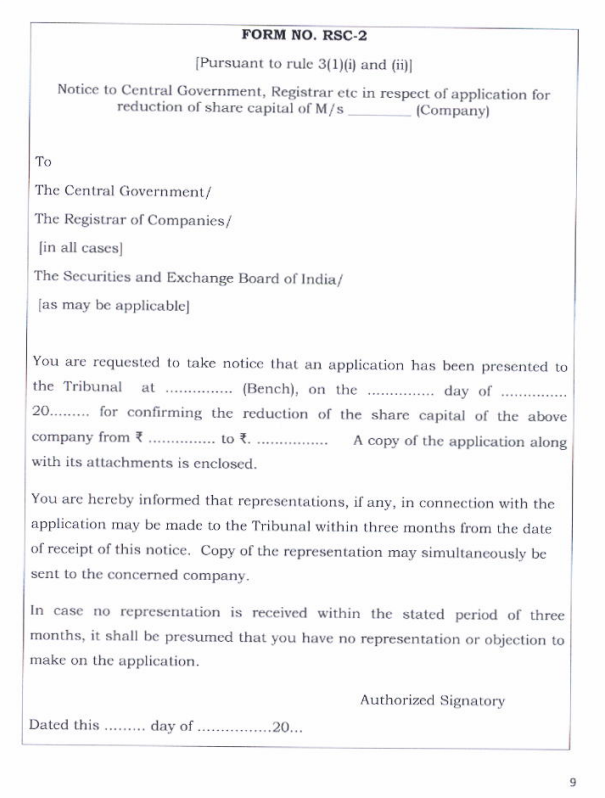
In every case, the Tribunal must send (or direct sending of) a notice to:
The Central Government
The Registrar of Companies
The notice has to be sent using Form RSC-2.
If the company applying for capital reduction is listed, a notice must also be sent to:
The Securities and Exchange Board of India (SEBI)
In this case also , the notice must be sent Using Form RSC-2.
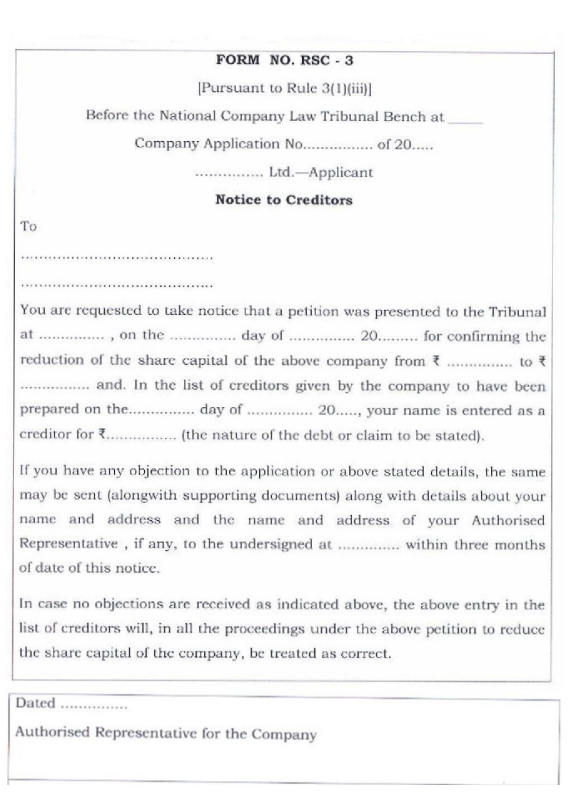
In all cases, notice must be given to all creditors of the company using Form RSC-3.
Each person/authority receiving the notice is invited to submit Representations, and Objections, if any to the proposed reduction of share capital.
(2).
The notice must be sent within seven days of the Tribunal’s direction (or within any other period specified by the Tribunal).
The notice must be sent to each creditor whose name appears in the list of creditors submitted by the company.
The notice must inform the creditors about the presentation of the application for reduction of share capital.
The notice must include a copy or details of the list of creditors.
It must state the amount of the proposed reduction of share capital.
It must state the amount or estimated value of the creditor’s debt, including any contingent debt or claim, as entered in the list.
(3).
When the Tribunal issues directions for sending notices it must also give directions for publishing a public notice.
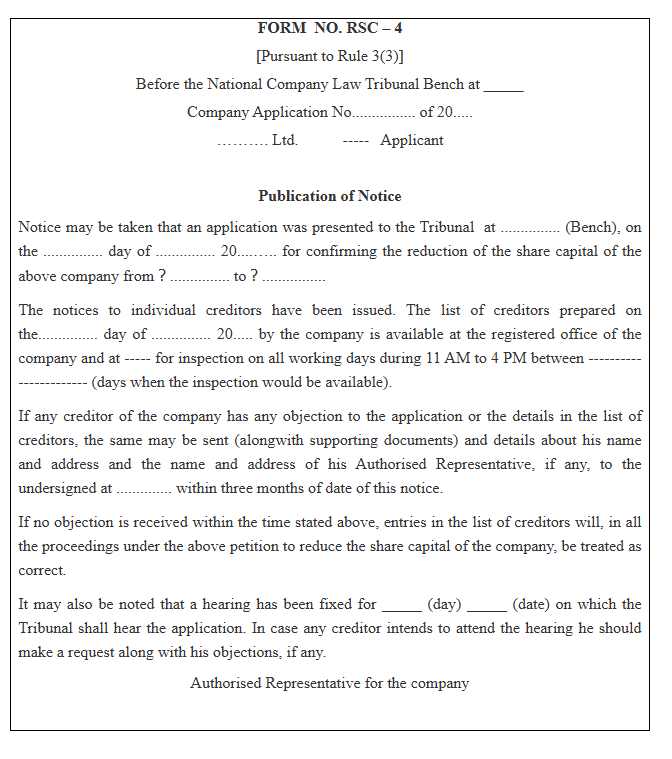
The notice must be published in Form No. RSC-4.
The notice must be published within 7 days from the date the Tribunal gives these directions.
It has to be published in:
(a). In English newspaper
A leading English-language newspaper.
Having wide circulation in the State where the company’s registered office is located.
(b). In vernacular (local language) newspaper
A leading newspaper in the regional/vernacular language
Also with wide circulation in that State
Any other newspapers that the Tribunal specifically directs.
If the company has a website, the notice must also be uploaded on the website.
The published notice must:
Invite objections from creditors and any other concerned persons
Inform the public about the date of the hearing fixed by the Tribunal
(4).
The notice must clearly state the following:
Amount of the proposed reduction of share capital and How much capital the company plans to reduce.
The places where the list of creditors can be inspected:
The registered office, or any other specified location
These are places where creditors or the public can inspect the official list of creditors.
Time limit (fixed by the Tribunal) for creditors to send objections
The Tribunal sets the response period.
This time limit must be mentioned clearly in the notice.
Creditors must file their objections with the Tribunal within three months from the date of publication of the notice.
A copy of the objection must also be served on the company.
(5).
After the Tribunal directs the company to send notices and publish the public notice in newspaper:
The company must prove that these notices were actually sent and published.
To do this, the company (or the person responsible) must file an affidavit with the Tribunal.
The affidavit can also be filed by the person who was directed by the Tribunal to send and publish the notices
The affidavit must confirm that:
All required notices were sent/despatched.
The public notice was published in the newspapers as directed.
The affidavit must be filed:
As soon as possible, but not later than 7 days from the date the notices were issued or published.
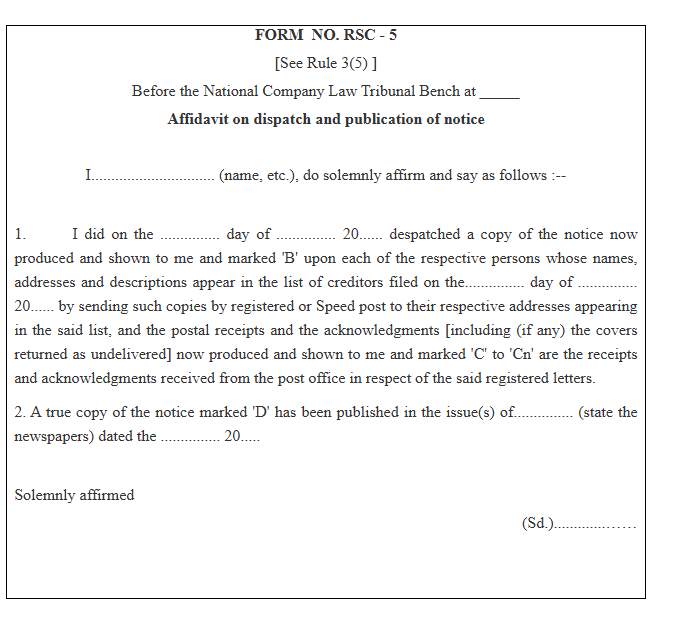
The affidavit must be in Form No. RSC-5.
(6).
If the Tribunal is satisfied that all creditors are fully protected, it may skip the requirement of:
Sending notices to creditors,
Publishing the public notice,
Or both.
This is done only if every creditor’s position is protected in one of these ways:
Their debt has been fully paid (discharged).
Their claim has been determined (settled/decided).
Their debt has been secured (company gives security to protect the creditor).
The creditor has given written consent to the capital reduction.
Representations or objections to the proposed reduction of share capital may be filed by the Central Government & Registrar of Companies (RoC).
SEBI may file representations or objections, but only in the case of listed companies.
Creditors of the company are also entitled to file representations or objections.
All of these parties receive notices under Rule 3 regarding the proposed reduction.
After receiving the notice, they have a right to respond if they have any concerns or objections.
They are required to send their representation or objection to the Tribunal.
The time limit for sending the representation or objection is three months.
For the Central Government, RoC, and SEBI, this three-month period is calculated from the date they received the notice.
For creditors, the three-month period is calculated from the date of publication of the notice.
This distinction exists because authorities receive direct notices, whereas creditors rely on public notice.
A copy of every representation or objection must also be sent to the company.
If the Tribunal does not receive any representation or objection within the three-month period, it treats this silence as no objection.
The Tribunal then proceed with the application without waiting indefinitely for replies.
Rule 5. Procedure with regard to representations and objections receive
(1).
After the period for filing objections or representations (usually 3 months) is over, the company has a duty to report everything to the Tribunal.
The company must collect all objections/representations received.
These may come from:
Creditors.
Central Government.
Registrar of Companies.
SEBI (for listed companies).
For each objection or representation received, the company must prepare its written response or explanation.
The company must file:
All the objections/representations received.
The company’s replies to each one.
This must be done within 7 days after the last date for receiving objections has expired.
(2).
Once objections are received, the Tribunal may issue any directions it finds appropriate, including:
Holding an enquiry
The Tribunal may conduct an enquiry to verify:
Whether the list of creditors is accurate.
The financial position of the company.
Whether the interests of creditors are properly protected.
Adjudication of claims
The Tribunal can examine and decide:
Whether a creditor’s claim is genuine.
The exact amount owed to the creditor.
Whether the claim has been settled, secured, or otherwise satisfied.
Hearing objections
If objections have been filed, the Tribunal may:
Hold a hearing on the objections.
Allow both the creditor and the company to present their case.
Decide whether the objection is valid or not.
Any other directions
The Tribunal may pass any other orders necessary to ensure:
Fairness.
Proper examination of all issues.
Smooth processing of the capital reduction application.
(3).
The Tribunal may order the company to provide adequate security for the debts or claims of such creditors.
This may include:
Providing a bank guarantee.
Creating a charge on the company’s assets.
Depositing money in a designated account.
Offering any other form of security that ensures the creditor will not suffer a loss.
If the Tribunal gives directions to secure the debts, it may:
Adjourn (delay) the further hearing of the petition.
Allow the company time to comply with the directions.
So, the application for reduction will not move forward until the company shows it has implemented the Tribunal’s orders and protected creditor interests.
To Access Form: RSC -2: https://ca2013.com/wp-content/uploads/2016/12/Form-No.-RSC-2.pdf
To Access Form RSC -3: https://ca2013.com/wp-content/uploads/2016/12/RSC-3.pdf
To Access Form RSC -4: https://ca2013.com/wp-content/uploads/2016/12/RSC-4.pdf
To Access Form RSC -5: https://ca2013.com/wp-content/uploads/2016/12/RSC-5.pdf
Rule 6. Order on application and Minute thereof
(1).
When the Tribunal confirms a reduction of share capital, it issues an order.
This order includes:
Confirmation of the reduction.
Approval of the minute describing the details of the reduction.
The Tribunal may also include any directions, terms, or conditions that it considers appropriate.
(2).
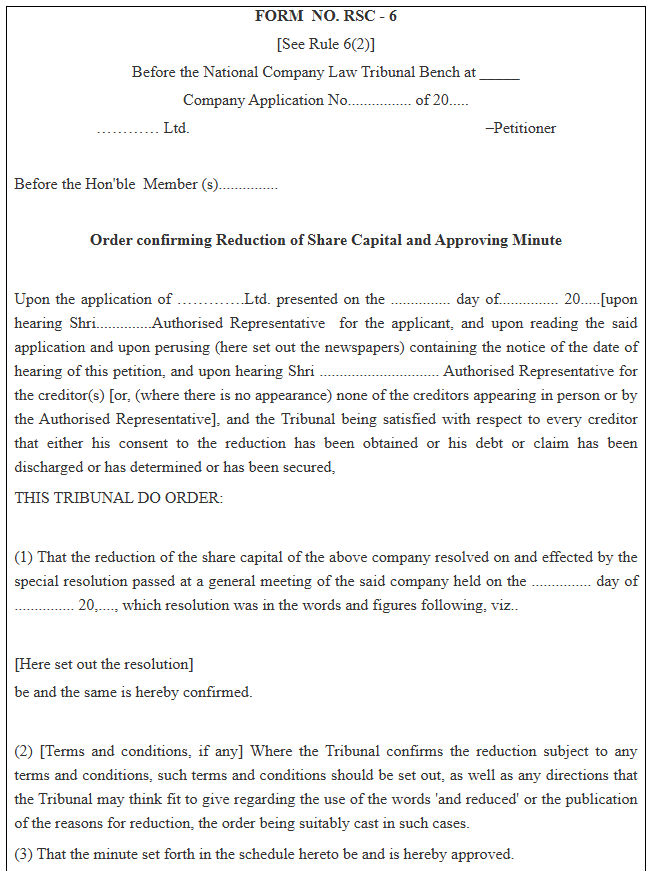
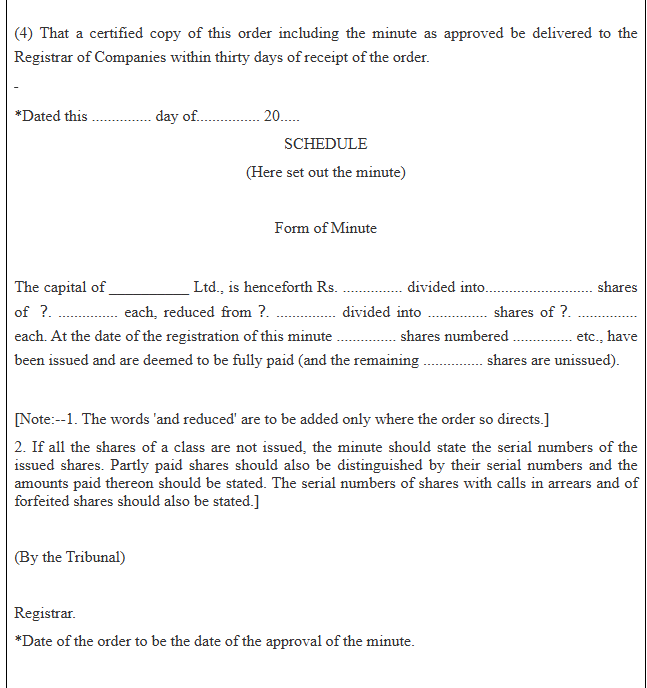
The Tribunal issues an order confirming the reduction of share capital.
The same order also approves the minute relating to the reduction.
This order must be in Form No. RSC-6.
The order can include any terms and conditions that the Tribunal considers appropriate.
(3).
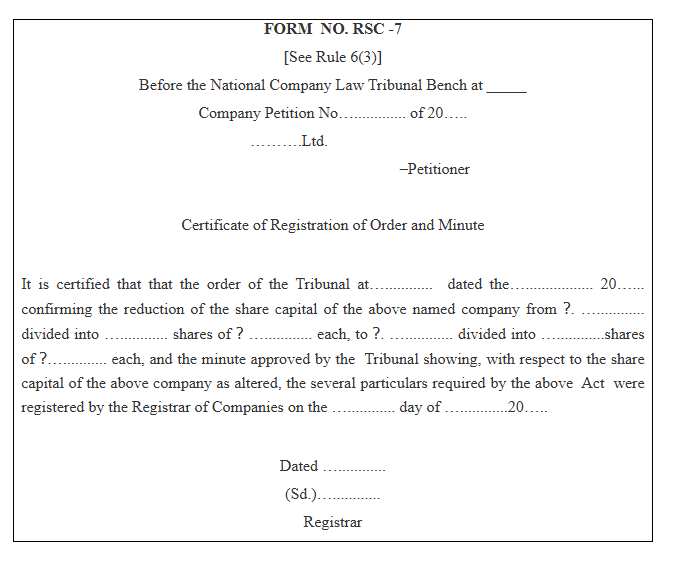
The Registrar issues a certificate under Section 66(5) after the reduction of share capital is confirmed.
This certificate must be in Form No. RSC-7.
To Access Form RSC - 6: https://ca2013.com/wp-content/uploads/2016/12/RSC-6.pdf
To Access Form RSC - 7: https://ca2013.com/wp-content/uploads/2016/12/RSC-7.pdf