Incorporation Rules (Rule 21-30)
Rule 21. Conditions for Conversion of a Company Registered Under Section 8 into a Company of Any Other Kind
1.
If a company that is currently registered under Section 8 (meaning it is a non-profit company) wants to convert into any other type of company (for example, a private limited or public limited company), it must:
Conduct a general meeting, and
Pass a special resolution approving the conversion.
A special resolution requires approval by at least 75% of members present and voting.
2.
When the company sends the notice calling the general meeting, it must attach an explanatory statement.
This statement must explain why the company wants to convert.
It must include all the points below:
(a). The date on which the company was incorporated.
(b). The main objects of the company as written in its Memorandum of Association (MOA).
(c). The reasons why the company can m no longer carry on its activities as a Section 8 company. Essential the reasons should explain why the current non-profit structure does not work anymore.
(d). If the company wants to change its main objects, it must mention:
What the new objects will be, and
Why these new objects are necessary.
(e). A full list of benefits, exemptions, and concessions that the company currently enjoys as a Section 8 entity, such as:
Income-tax exemptions
Permission to receive donations (including foreign contributions under FCRA)
Land, buildings, or assets received at reduced prices or for free
Any donations or bequests received with conditions attached
If the company got land or property at a concessional price or free:
It must mention the market value at that time,
And how much the company actually paid.
(f) Details of how the conversion will affect the members, including:
Whether they will receive any benefits after the conversion
Any change in rights, obligations, or control
After passing the special resolution, the company must file:
A certified copy of the special resolution,
A copy of the notice of the meeting,
And the explanatory statement with the Registrar of Companies (ROC) in Form MGT-14, along with the prescribed fee.
3.
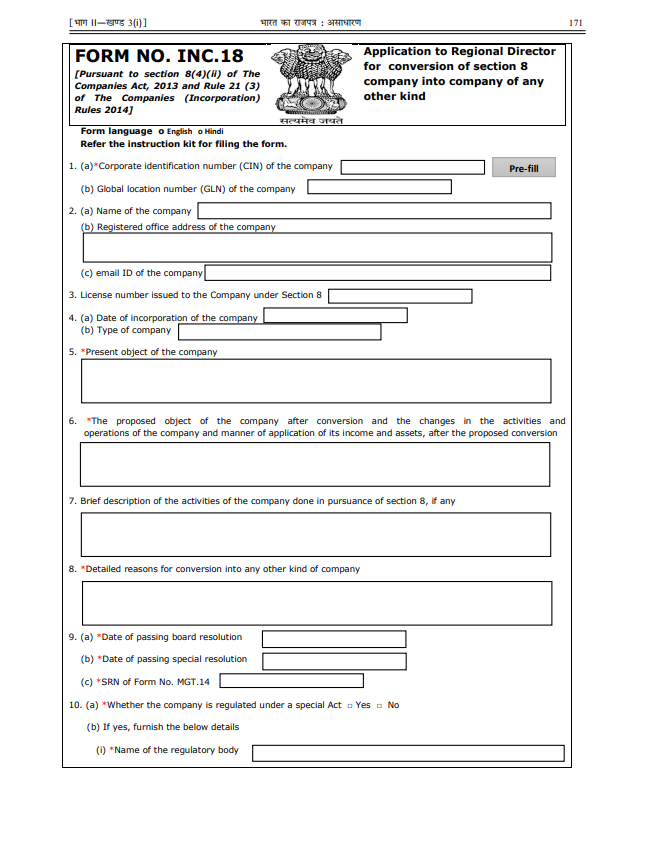
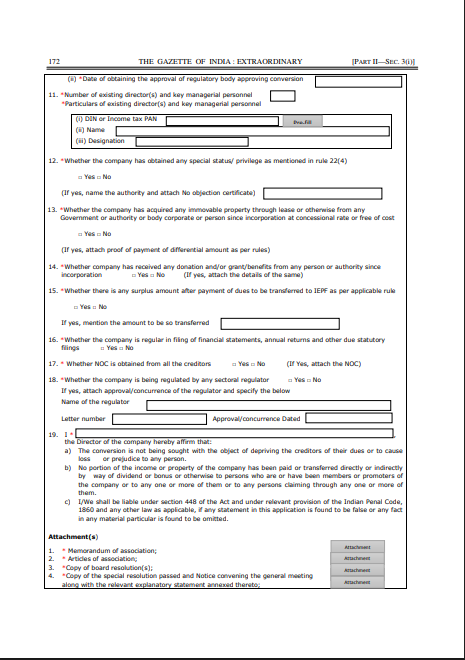
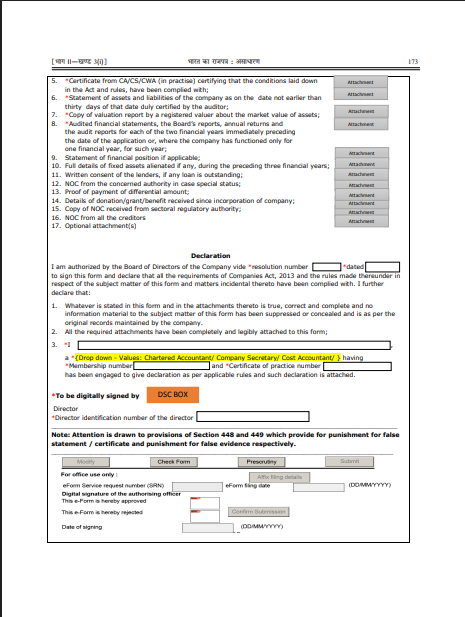
the company must file an application for conversion with the Regional Director (RD) in:
Form INC-18, along with the required fee.
This application must include:
A certified true copy of the special resolution,
A copy of the notice and explanatory statement,
And proof that the company has sent notice of the proposed conversion to all authorities listed under Rule 22(2) (for example, tax authorities, charity commissioner, etc.).
4.
A copy of the same application, along with all annexures that were sent to the RD, must also be filed with the Registrar of Companies (ROC).
To access INC - Form 18: https://ca2013.com/wp-content/uploads/2015/07/inc-18.pdf
Rule 22. Other Conditions to be Complied With by Companies Registered Under Section 8 Seeking Conversion into Any Other Kind
1.
Within one week after submitting the conversion application to the Regional Director (RD), the company must:
Publish a public notice (in Form INC.19) at its own cost.
Send a copy of the published notice immediately to the RD.
The notice must be published:
Once in a vernacular (local language) newspaper with wide circulation in the district where the registered office is located; and
Once in an English newspaper with wide circulation in that same district.
On the company’s website, if it has one and on any other website/platform notified by the Central Government.
2.
At the same time as publication, the company must send:
A copy of the notice,
A copy of the application,
And all attachments to each of the following by registered post or hand delivery:
Chief Commissioner of Income Tax
Income Tax Officer with jurisdiction over the company
Charity Commissioner (if applicable)
Chief Secretary of the State
Any Central/State Government department or authority under which the company operates
Any other concerned authority
These authorities may send representations/objections to the RD within 60 days of receiving the notice.
Before sending objections, they must give the company a fair chance to explain.
3.
The company must also attach proof that these notices were served to accompany the application.
Examples: postal receipts, acknowledgements, hand-delivery signatures.
4.
The Board of Directors must give a formal declaration stating that:
No income or property of the company has ever been, or will ever be, distributed to its members by way of dividend, bonus, or any similar benefit.
This reconfirms the non-profit character prior to conversion,
If the company has received any special privilege, such as:
Tax exemptions
Government grants
Land or property at concessional rates
Any other benefit then:
It must obtain a No Objection Certificate (NOC) from that authority if the terms of that privilege require such permission,
And file the NOC with the RD along with the application.
5.
The company must have filed all financial statements and annual returns up to the financial year before applying for conversion.
Additionally:
If the application is filed more than 3 months after the last financial statements filed,
The company must attach a fresh financial statement certified by a Chartered Accountant,
Prepared not more than 30 days before filing the application.
6.
With the application, the company must attach a certificate from a practicing:
Chartered Accountant, or
Company Secretary, or
Cost Accountant
This certificate must confirm that all legal requirements for conversion (under the Act and these rules) have been fully complied with.
7.
The RD may ask the company to:
Provide approvals from any specific authority if needed, and/or
Wait while the RD obtains a report from the Registrar of Companies.
8.
If satisfied, the RD will issue an order approving the conversion, with conditions.
These conditions may include:
The company must give up all special status, privileges, exemptions, etc., that it enjoyed as a Section 8 company, from the date conversion becomes effective.
If the company received immovable property (e.g., land, buildings):
Free of cost, or
At a concessional price,
From any government or authority
Then the company may be required to pay back the difference between:
The concessional price it paid, and
The market price at the time of conversion.
Payment may have to be made to the government or authority that provided the property.
Any accumulated profit or unutilised income of the company must be used in this order:
Pay all statutory dues
Pay amounts due to lenders
Pay claims of creditors, suppliers, service providers
Pay dues to employees
Pay back loans from promoters/members
Whatever remains must be transferred to the Investor Education and Protection Fund (IEPF) within 30 days of receiving RD approval.
9.
Before imposing conditions or rejecting the application, the RD must give the company a reasonable opportunity to be heard.
10.
After receiving RD approval the company must hold a general meeting and pass a special resolution to amend:
Its Memorandum of Association, and
Articles of Association to reflect that it is no longer a Section 8 company.
The company must then file with the ROC:
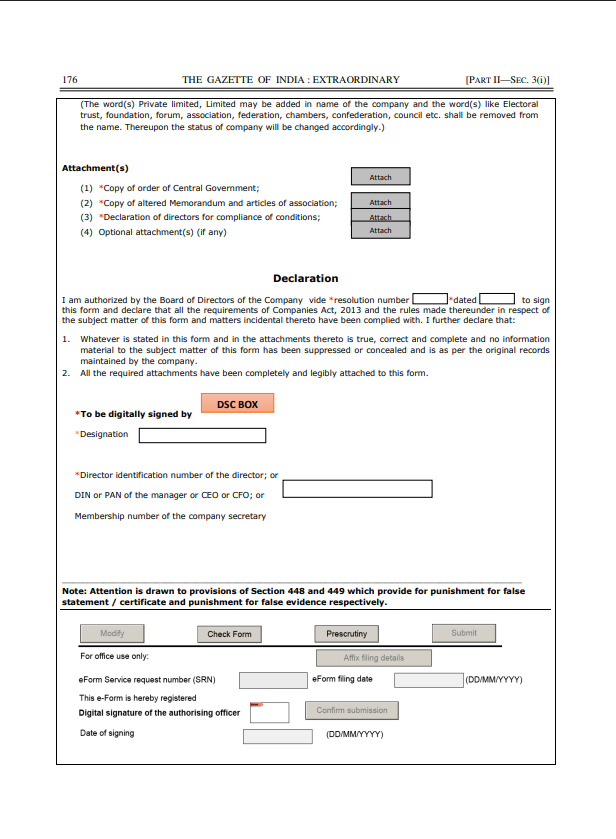
A certified copy of the RD’s approval order, within 30 days, in Form INC.20, with the fee.
The amended MOA and AOA.
A declaration by the directors confirming that all conditions imposed by the RD have been fully complied with.
11.
After receiving all documents under (10), the Registrar will:
Register the new documents, and
Issue a fresh Certificate of Incorporation.
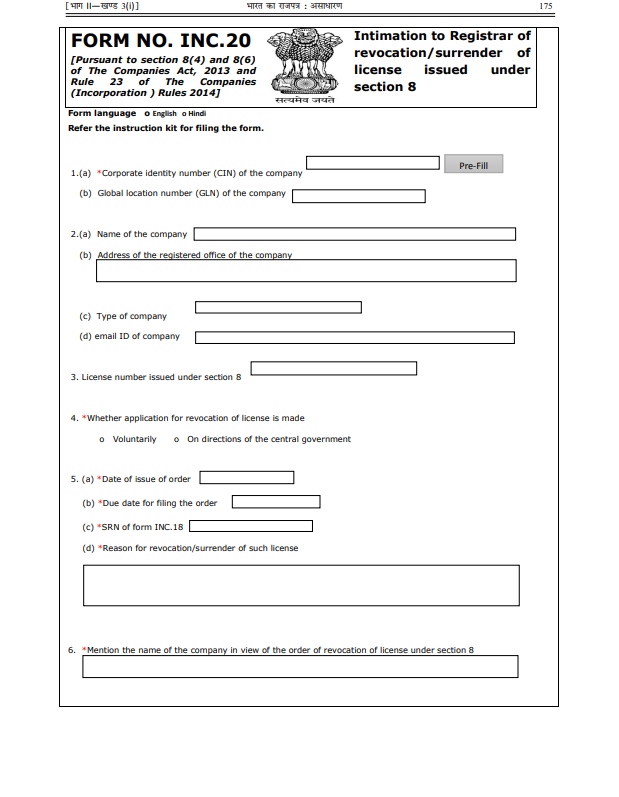
To access Form INC - 20: https://ca2013.com/wp-content/uploads/2015/07/inc-20.pdf
Rule 23. Intimation to Registrar of Revocation of Licence Issued Under Section 8
If the licence of a Section 8 company is cancelled or revoked, the company must inform the Registrar of Companies (ROC).
This is not optional and it is a legal requirement.
To inform the Registrar, the company must file Form INC.20.
This form is used to:
Notify ROC that the Section 8 licence has been revoked
Apply for conversion of the company’s status (because it can no longer function as a Section 8 company)
Apply for change of name (because Section 8 companies have restrictions on name, like “Foundation”, “Association”, etc.)
The form must be filed with the prescribed filing fee as per the Companies (Registration Offices and Fees) Rules.
Through this filing, the company formally begins the process of:
Removing Section 8 status
Adopting a normal company structure (private limited, public limited, etc.)
Getting a new certificate of incorporation with the revised name.
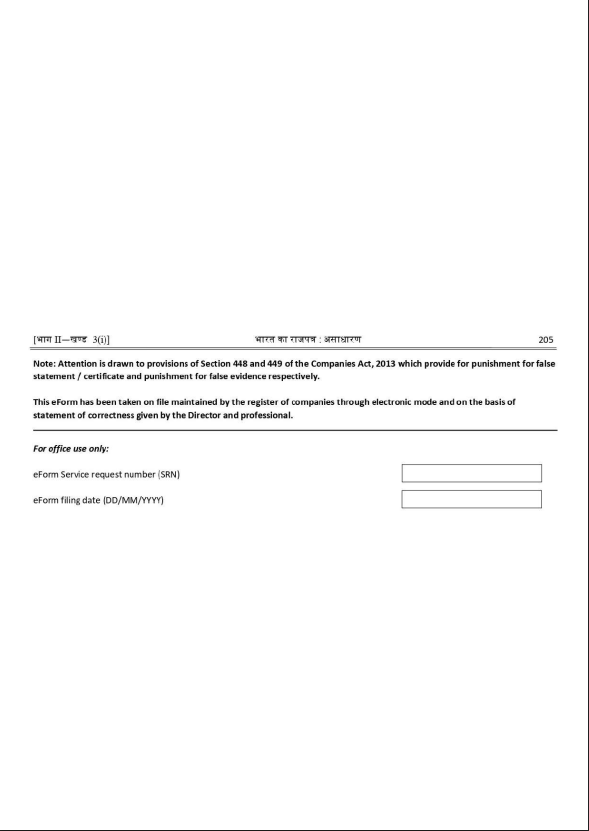
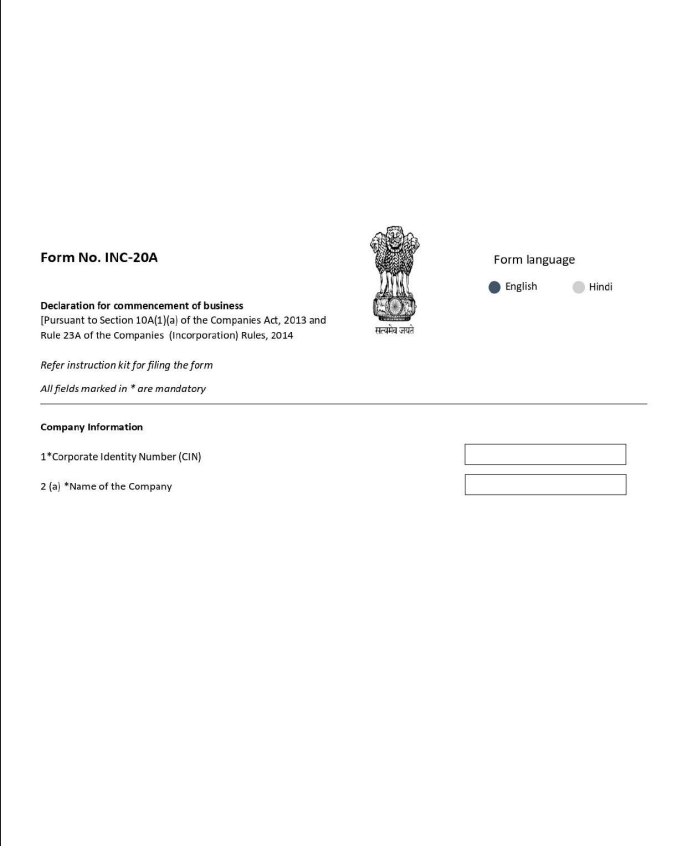
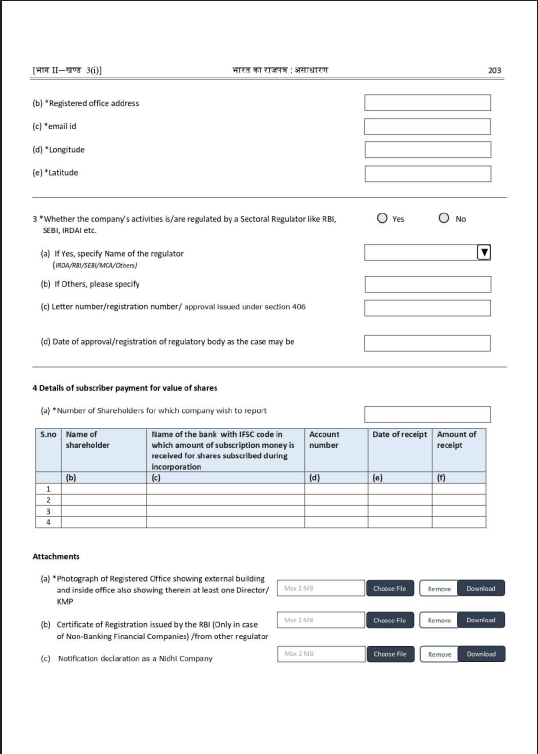
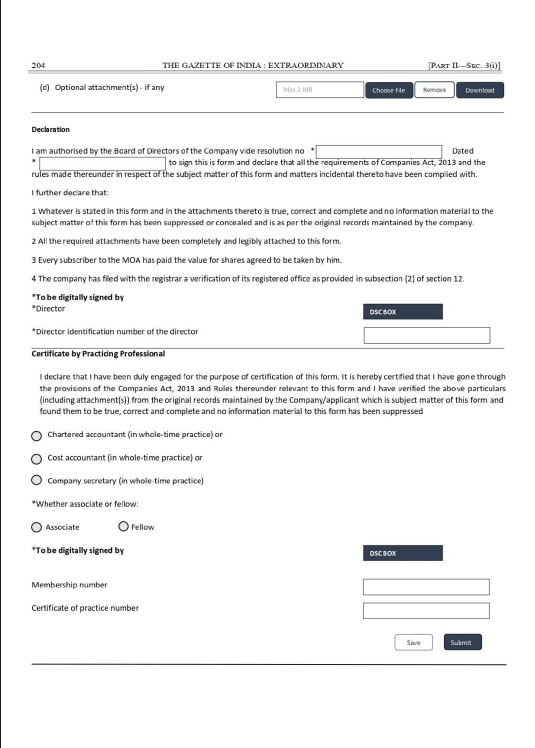
Rule 23A. Declaration at the Time of Commencement of Business
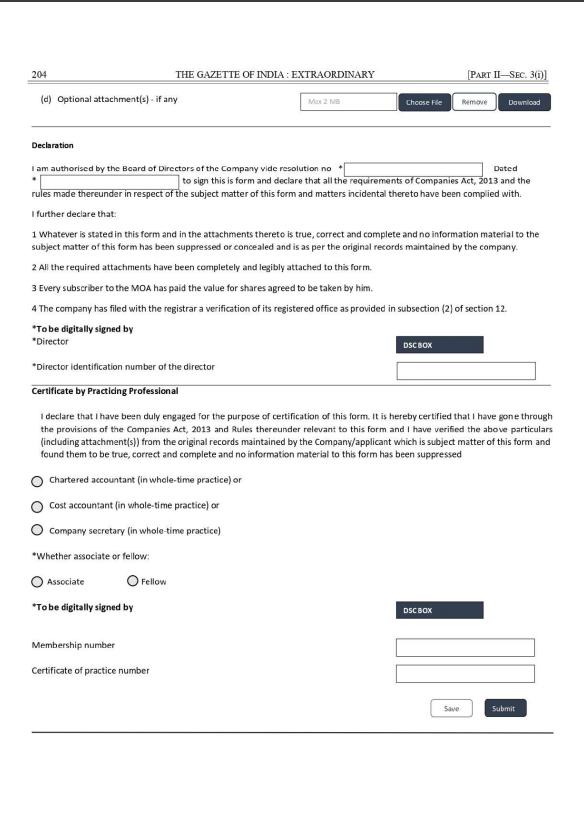
A director of the company must submit a declaration stating that:
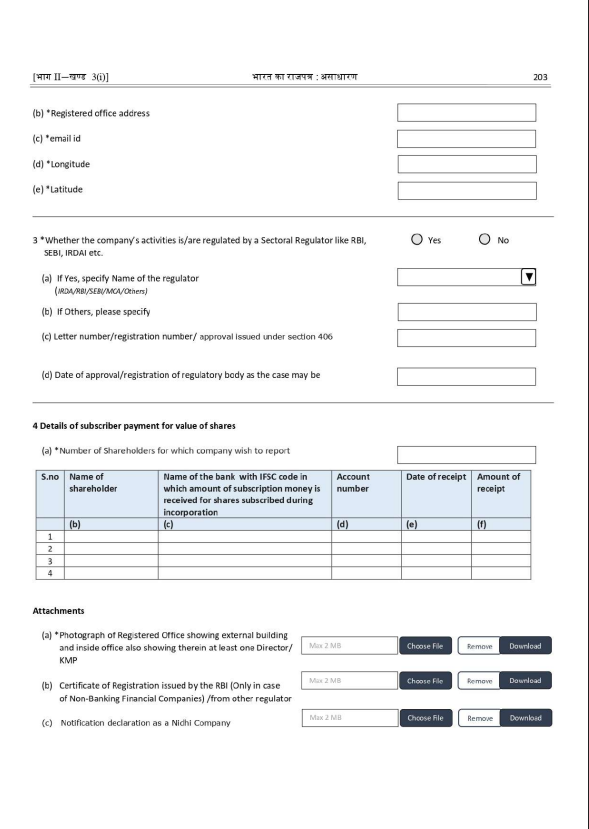
Every subscriber to the Memorandum has paid the value of the shares they agreed to take.
The company has verified its registered office.
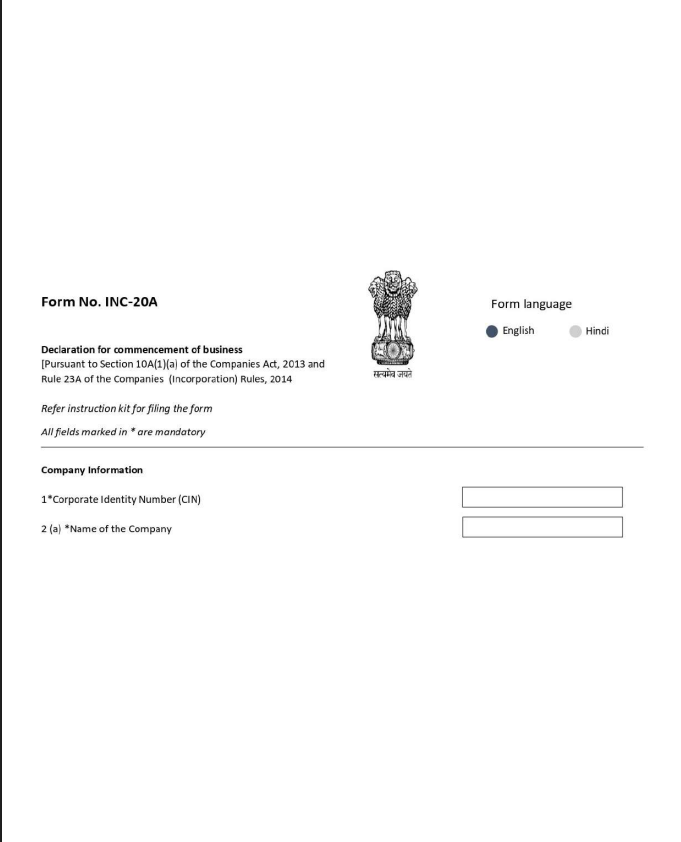
This declaration must be filed in Form INC-20A with the Registrar.
The contents of Form INC-20A must be verified and certified by:
A Company Secretary in practice, or
A Chartered Accountant in practice, or
A Cost Accountant in practice
If the company’s business requires approval from any sectoral regulator, such as:
Reserve Bank of India (RBI)
Securities and Exchange Board of India (SEBI)
Insurance Regulatory and Development Authority (IRDAI)
Any other regulator depending on the object
Then:
The company must obtain that approval or registration first and attach the approval along with Form INC-20A. Without attaching these approvals, the declaration is considered incomplete.
To access Form INC - 20-A: https://ca2013.com/wp-content/uploads/2023/01/Form-INC-20A.pdf
Rule 24. Notice and Verification of Change of Situation of the Registered Office
A director of the company must submit a declaration in Form INC-21 with the required fee.
The contents of Form INC-21 must be verified and certified by any one of the following:
A Company Secretary in practice
A Chartered Accountant in practice
A Cost Accountant in practice
If the company operates in a sector that requires specific approval or registration from regulators like:
Reserve Bank of India (RBI)
Securities and Exchange Board of India (SEBI)
Any other similar authority
Then the company must obtain that regulator’s approval first, and such approval must be attached with Form INC-21.
Rule 25. Verification of Registered Office
1.
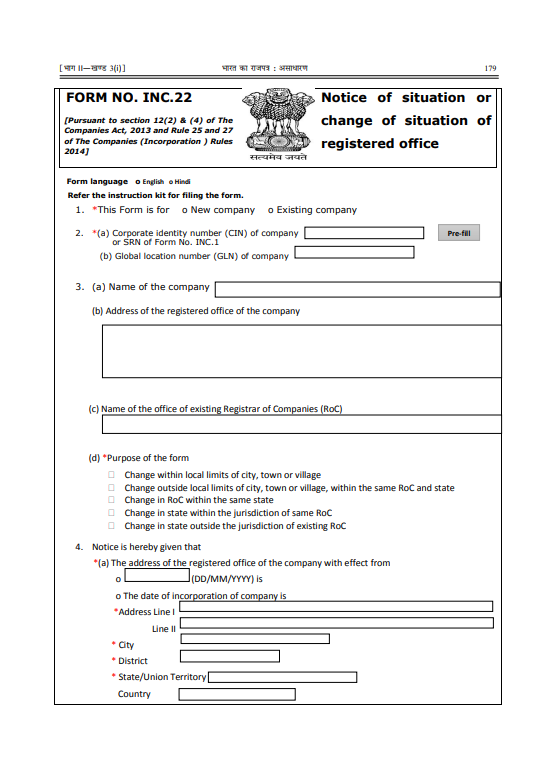
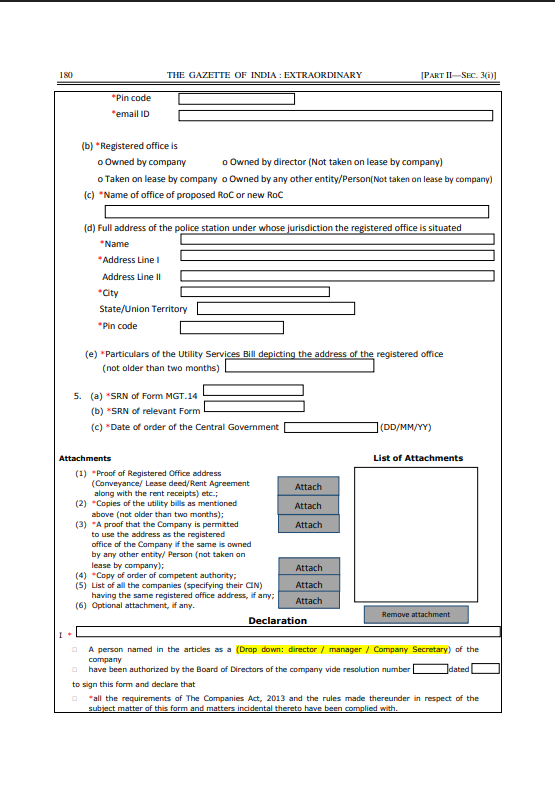
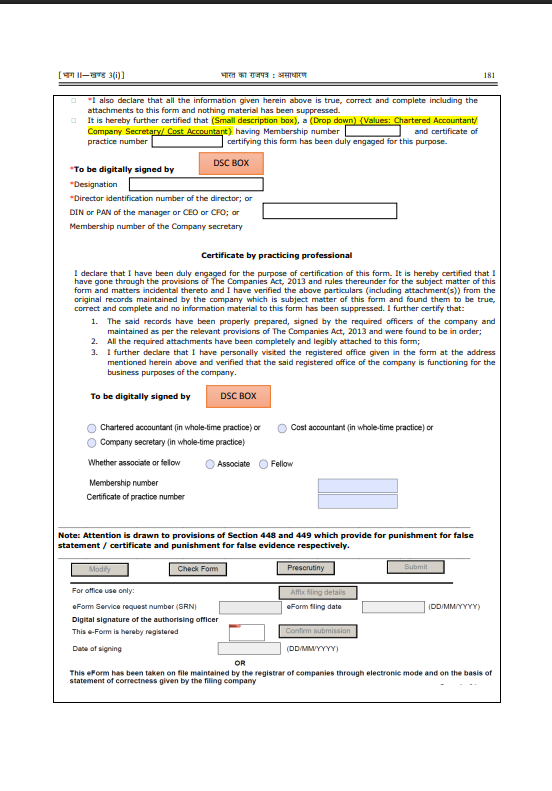
The company must submit Form INC-22 to the Registrar with the required fee.
2
Along with the form, the company must attach one or more supporting documents from the following list to prove that the registered office address is valid and genuine:
(a). If the company owns the property, it must attach the official registered title document showing that the property is in the company’s name.
(b). If the company rents the office space, it must attach:
A notarized lease or rent agreement in the company’s name, and
A recent rent receipt, not older than one month.
(c). If the company is using a premises that it does not own or rent directly, then it must provide:
A written authorization from the owner or the authorized occupant, giving permission to use the premises as the registered office, and
Proof of ownership or occupancy by that owner/occupant (for example, their sale deed, electricity bill, etc.).
(d). The company must attach a recent copy of any utility service document, such as:
Telephone bill
Gas bill
Electricity bill
This document must show the address of the premises and must be in the name of the owner of the premises (or authorized occupant).
The bill must be not older than two months.
To access Form INC-22- https://ca2013.com/wp-content/uploads/2015/07/inc-22.pdf
Rule 25. A Active Company Tagging Identities and Verification (ACTIVE)
1.
Every company that was incorporated on or before 31 December 2017 must file its basic details and its registered office details in e-Form ACTIVE (Active Company Tagging Identities and Verification).
The original deadline to file this form was 15 June 2019.
Companies that have not filed their due financial statements (Section 137) or annual returns (Section 92), or both, cannot file e-Form ACTIVE.
Exception: If a company is under a management dispute and the Registrar has officially recorded that dispute, then it is allowed to file the form.
Companies that are struck off, being struck off, under liquidation, amalgamated, or dissolved are not required to file Form ACTIVE.
This is because they are not functioning as active companies.
ACTIVE filing applies only to companies that are currently operational and listed as active in the ROC records..
If a company fails to submit the ACTIVE form, it will be marked as “ACTIVE-non-compliant” (from 16 June 2019).
Such companies may face action under section 12(9).
In addition, the Registrar will not accept filings for certain important changes until ACTIVE is filed.
The following forms cannot be filed by an “ACTIVE-non-compliant” company:
SH-07 – Change in authorised share capital
PAS-03 – Change in paid-up share capital
DIR-12 – Director changes, except the following cases:
(a) cessation/removal of a director
(b) appointment of directors when the total number of directors has fallen below the legal minimum due to disqualification under section 164
(c) appointment of directors when DINs of existing directors have been deactivated
(d) appointment of directors needed to comply with an order of a Court, Tribunal, Appellate Tribunal, or under IBCINC-22 – Change in registered office
INC-28 – Filing orders for amalgamation, demerger, etc.
Until the company files e-Form ACTIVE, none of these filings will be accepted.
2.
If the company files e-Form ACTIVE on or after 16 June 2019, it will be marked as “ACTIVE Compliant”.
A fee of ₹10,000 is required for late filing.
Forms mentioned in this rule:
e-Form ACTIVE
SH-07
PAS-03
DIR-12
INC-22
INC-28
25B Physical verification of the Registered Office of the company
1.
The Registrar of Companies (RoC), on the basis of information or documents available on the MCA-21 portal, may visit the company’s registered office and conduct a physical verification of the premises as required under Section 12(9).
This verification must take place in the presence of two independent local witnesses, and the Registrar may request assistance from the local police if needed.
2.
During the visit, the Registrar must carry the documents filed on MCA-21 that support the company’s registered office address.
These documents will be cross-checked with copies of supporting documents obtained from the occupant of the premises, and the cross-verified documents must be duly authenticated.
3.
The Registrar must take a photograph of the registered office during the physical verification process.
4.
After completing the verification, the Registrar must prepare a formal report in the prescribed format.
The report includes the following details:
Name and CIN of the company
Latest registered office address as per MCA-21 records
Date of authorisation letter issued by RoC
Name of the Registrar of Companies
Date and time of physical verification visit
Location details and landmark
Details of any person present at the premises:
(i) Name
(ii) Father’s Name
(iii) Residential address
(iv) Relationship with the company, if applicable
Remarks, if any
Attached documents:
(i) Copy of ownership/lease/rent agreement or NOC from owner/lessor/tenant
(ii) Photograph of the registered office
(iii) Self-attested ID card of the person present, if any
(iv) Any other relevant document.
The report must include the date, place, signature, name, designation, and official address of the verifying officer.
5.
If, upon verification, the registered office is found not capable of receiving or acknowledging communications or notices, the Registrar must issue a notice to the company and all its directors.
The notice will state the Registrar’s intention to remove the company’s name from the register under Section 248, unless the company submits valid representations with supporting documents within 30 days from the date of the notice.
Rule 26. Publication of Name by Company
Central Government has the power to specify more documents other than the ones already listed in the Act or Rules on which a company must print its full legal name (for example, letters, invoices, notices, etc.).
So, whenever the Government feels it is necessary, it can add more categories of documents by issuing a notification.
Once notified, companies must also print their names on those newly-specified documents.
Rule 27. Notice and Verification of Change of Situation of the Registered Office
When the company changes its registered office, it must file Form INC-22 with the required fee.
The form must include the same documents used for verifying the registered office at incorporation (as per section 12(2)).
These documents may include title documents, lease or rent agreement, utility bill, or owner’s authorization.
Rule 28. Shifting of Registered Office Within the Same State
1. Application to Regional Director
Company must file an application to the Regional Director (RD) in Form INC.23 with the required fee.
This is required when shifting the registered office within the same State but from one Registrar of Companies’ jurisdiction to another.
2. Notices before filing the application (at least 1 month before)
Publish a notice:
Once in an English daily newspaper.
Once in a newspaper in the principal local language of the district.
Both newspapers must circulate in the district of the current registered office.
Send individual notices to:
Every debenture holder.
Every depositor.
Every creditor.
Notice must mention:
The proposed change of registered office.
That any affected person can write to the Regional Director stating their interest and grounds of opposition.
They must send this within 21 days from the date of newspaper publication.
A copy of the objection must also be sent to the company.
Additional conditions
If no objection is received by the Regional Director within 21 days from the date of service or publication of the notice, the person is deemed to have given consent to the proposed change of registered office.
The Regional Director will not allow the shifting of the registered office if:
Any inquiry has been initiated against the company, or
Any inspection or investigation is ongoing, or
Any prosecution is pending against the company under the Act.
Rule 29. Alteration of Memorandum by Change of Name
1.
This rule explains when a company is not allowed to change its name. A change of name will be refused if the company has any of the following defaults:
If the company has not filed its annual return, financial statements, or any document that it is legally required to file with the Registrar.
If the company has defaulted in repaying any matured deposits (deposits that have reached their due date).
If the company has defaulted in repaying matured debentures.
If the company has defaulted in paying interest on matured deposits or matured debentures.
(Meaning: unless the company clears all pending filings and financial dues, it cannot proceed with changing its name.)
2.
This rule explains the procedure for changing the name:
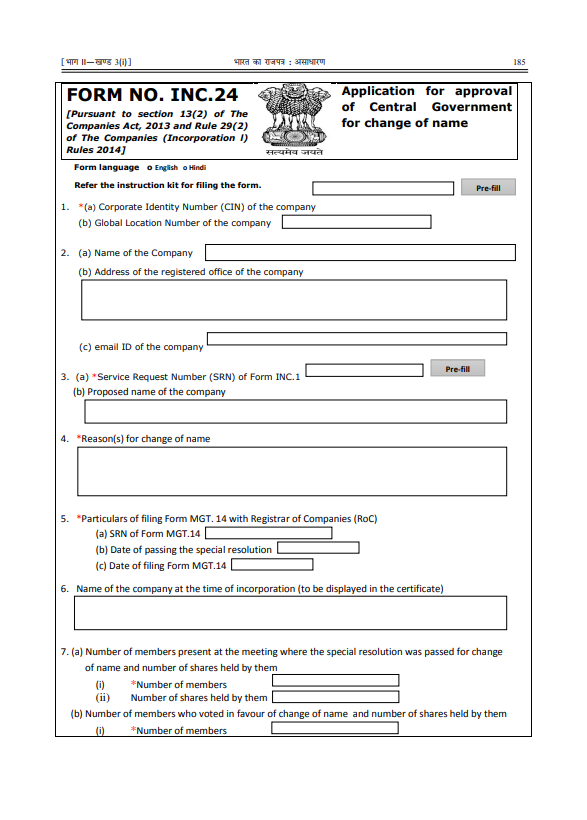
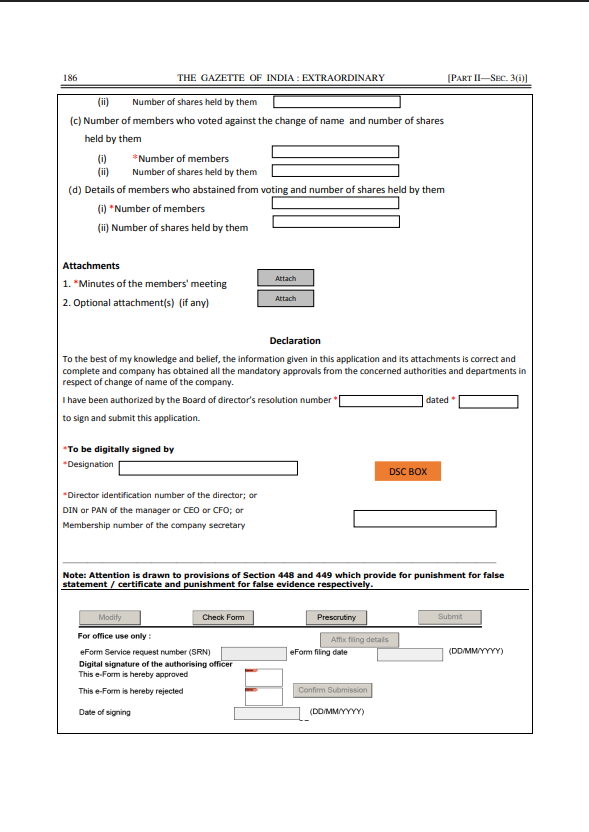
The company must file an application for name change in Form INC-24 along with the prescribed fee.
The Central Government examines and approves the request for change of name.
Once approved, the company will be issued a new Certificate of Incorporation in Form INC-25.
(This certificate shows the company’s new legal name, and the name change becomes effective from the date mentioned on the certificate.)
To Access INC Form 24: https://ca2013.com/wp-content/uploads/2015/07/inc-24.pdf
To Access INC Form 25: https://ca2013.com/returns/inc-25/

Rule 30. Shifting of Registered Office from One State or Union Territory to Another State
1.
A company must apply to the Central Government to change its registered office from one State/UT to another. The application must be filed in Form INC-23 along with the fee, and must include:
Copy of the Memorandum and Articles of Association
Copy of the notice calling the general meeting, with the explanatory statement
Copy of the special resolution passed by the members approving the shift
Copy of the minutes of the general meeting, showing the votes in favour and against
An affidavit verifying that the application is correct
List of creditors and debenture holders who can object
An affidavit verifying the correctness of the list of creditors
Proof of payment of the application fee
Copy of the board resolution or Power of Attorney or Vakalatnama authorising the filing
2.
A list of creditors and debenture holders must also be attached.
This list:
Must be prepared up to a date not older than one month before filing.
Must contain the name and address of every creditor and debenture holder.
Must show the amount due to each person.
The company must also attach an affidavit signed by:
The Company Secretary (if there is one), and
At least two directors (one must be the Managing Director if there is one)
The affidavit must state:
They have fully checked the company’s affairs
The list of creditors is correct
The estimated value of unascertained or contingent debts is accurate
There are no other debts or claims beyond what is listed
3.
The application must also include:
An affidavit from the directors stating that no employee will lose their job because of the shift
A copy of the application sent to the Chief Secretary of the State/UT from where the office is being shifted
4.
A properly authenticated copy of the creditors’ list must be kept at the company’s registered office.
Any person may inspect it during business hours and take extracts after paying up to ten rupees per page.
5.
The company must also attach proof that copies of the full application (with documents) have been sent to:
The Registrar of Companies
The Chief Secretary of the State/UT where the registered office currently is
6.
At least 14 days before the hearing date, the company must:
(a). Publish an advertisement (Form INC-26):
once in a newspaper in the main local language of the district
once in an English newspaper circulating in that district
(b) Send individual notices (by registered post with acknowledgement due) to:
Each creditor
Each debenture holder
and also send, by registered post:
A notice and a copy of the application to the Registrar
To SEBI (if the company is listed)
To any special regulatory authority (if the company is governed by a special law)
7.
If the company receives objections from anyone whose interest may be affected, it must forward a copy of the objection to the Central Government before the hearing date.
8.
If no objections are received from any of the people who were notified, the Central Government may decide the application without a hearing.
9.
Before approving the change, the Central Government will check that for every creditor or debenture holder who is allowed to object and who has objected:
He has given written consent, or
His debt or claim has been fully paid, or
His claim has ended, or
His debt or claim has been properly secured.
After this, the Central Government may confirm the alteration and can also impose any conditions it thinks necessary. It may also decide about costs.
The shifting of the registered office will not be allowed if:
Any inquiry, inspection or investigation has started against the company, or
Any prosecution is pending under the Act.
