Incorporation Rules (Rule 2-10)
Rule 2. Definitions
This rule explains the important terms used throughout the Incorporation Rules.
“Act” means the Companies Act, 2013.
“Annexure” means the attachments or schedules linked to these rules.
“Form” or “e-Form” means the official electronic forms notified by the government under the Act.
“Fees” are the amounts prescribed in the Companies (Registration Offices and Fees) Rules, 2014.
“Regional Director” means an officer appointed by the Central Government (Ministry of Corporate Affairs).
“Section” means a section of the Companies Act, 2013.
Any word not defined here but defined in the Act or the Companies (Specification of Definitions Details) Rules, 2014 will have the same meaning.
Rule 3. One Person Company (OPC)
Only a natural person who is an Indian citizen and resident in India can form or be a nominee of an OPC.
Resident in India is someone who stayed in India for at least 182 days in the previous calendar year.
A person can form or be a nominee in only one OPC at a time.
If a person accidentally becomes a member in more than one OPC, they must fix it within 180 days.
Minors cannot be members, nominees, or hold shares with beneficial interest in an OPC.
An OPC cannot be registered or converted as a Section 8 (non-profit) company.
It also cannot do non-banking financial investment activities, like investing in securities.
An OPC cannot voluntarily convert into another type of company unless:
2 years have passed since incorporation, OR
Its paid-up capital exceeds ₹50 lakh, OR
Its average annual turnover exceeds ₹2 crore.
Rule 4. Nomination by the Subscriber or Member of One Person Company
At the time of incorporation, the subscriber (founder) of a One Person Company (OPC) must nominate one person who will take over the company if the subscriber:
Dies, or
Becomes incapable of entering into contracts.
The nominee’s name must be mentioned in the Memorandum of Association (MoA) of the OPC.
The nomination is made in Form INC.2.
The nominee’s written consent must be obtained in Form INC.3.
Both forms, along with the required fees, must be filed with the Registrar of Companies (ROC) at the time of incorporation.
The nominee can withdraw consent at any time by giving written notice to:
The sole member (subscriber), and
The One Person Company.
In such a case, the sole member must:
Nominate another person within 15 days of receiving the withdrawal notice.
Obtain the new nominee’s written consent in Form INC.3.
Intimate the company in writing about the new nomination.
The company must then:
File Form INC.4 with the ROC within 30 days of receiving the withdrawal notice.
Attach the withdrawal notice and the new nominee’s consent (Form INC.3).
Pay the prescribed fee as per the Companies (Registration Offices and Fees) Rules, 2014.
The member can also change the nominee at any time (for any reason such as death or incapacity of the current nominee).
The member must obtain prior written consent of the new nominee in Form INC.3.
The company must file a notice of change with the ROC in Form INC.4 within 30 days, along with the new nominee’s consent and the prescribed fee.
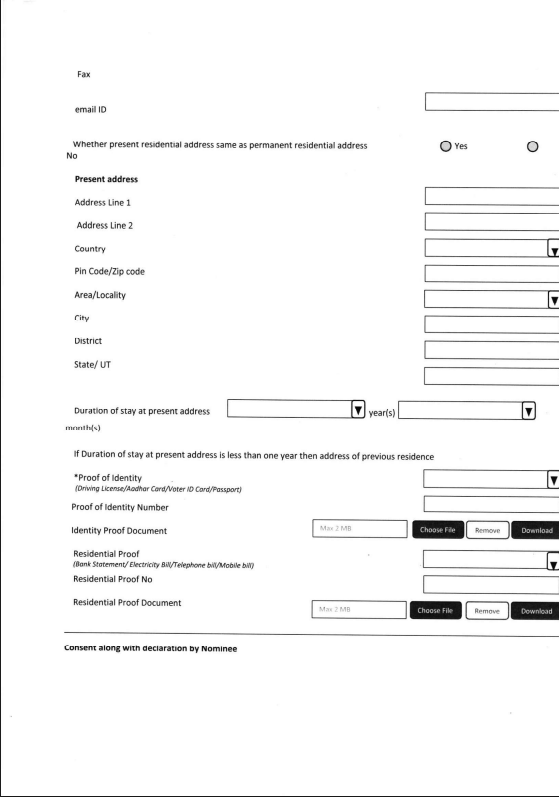
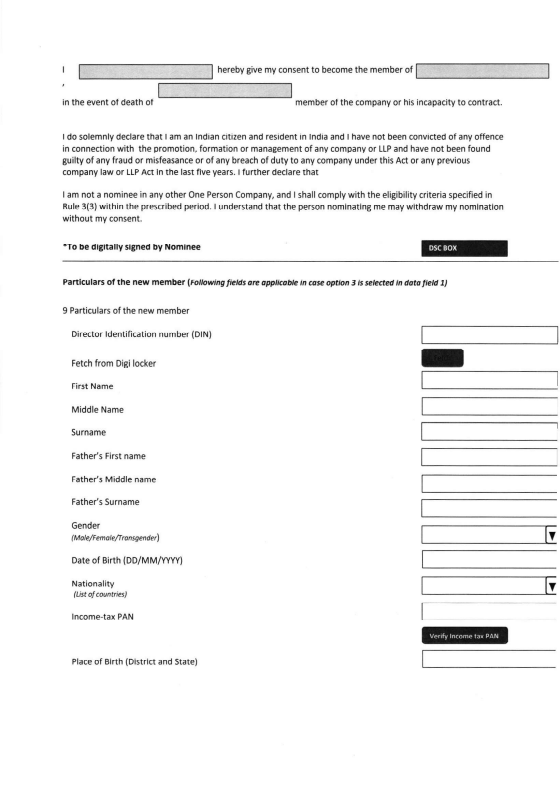
To Access Form INC 2: https://e-book.icsi.edu/notificationdetail.aspx?acturl=6CoJDC4uKVUR7C9Fl4rZdatyDbeJTqg31wjR0FsCYuFUF1UG2K3eCQ==
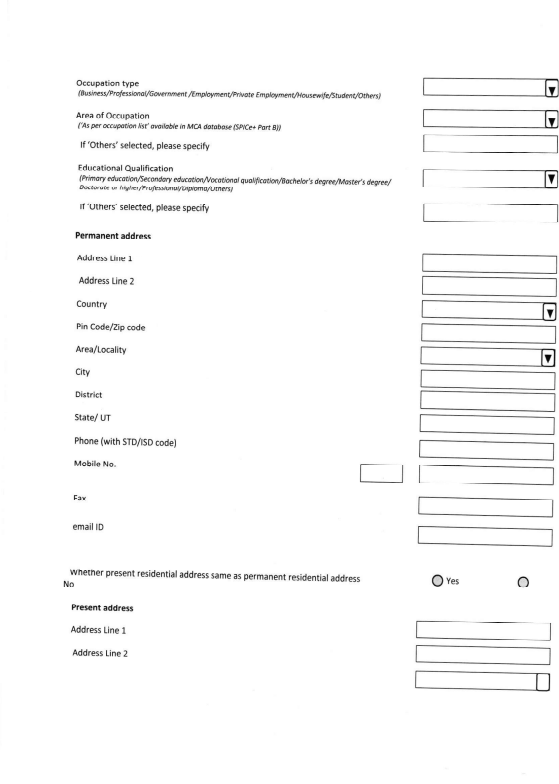
To Access Form INC 3: https://www.indiafilings.com/learn/wp-content/uploads/2023/06/Nominee-Consent-Form-%E2%80%93-One-Person-Company.pdf
However, it is important to note that Forms INC-2 and INC-3 have been omitted from the Companies (Incorporation) Rules, 2014.
Earlier, Form INC-2 was used for the incorporation of a One Person Company (OPC), and Form INC-3 was used to obtain the written consent of the nominee who would take over the OPC in case of the member’s death or incapacity.
With the introduction of the SPICe+ (Form INC-32) integrated web-based system by the Ministry of Corporate Affairs (MCA), these separate forms have become redundant.
All information relating to OPC incorporation including nominee details and consent is now provided directly within SPICe+ Part B, streamlining the process.
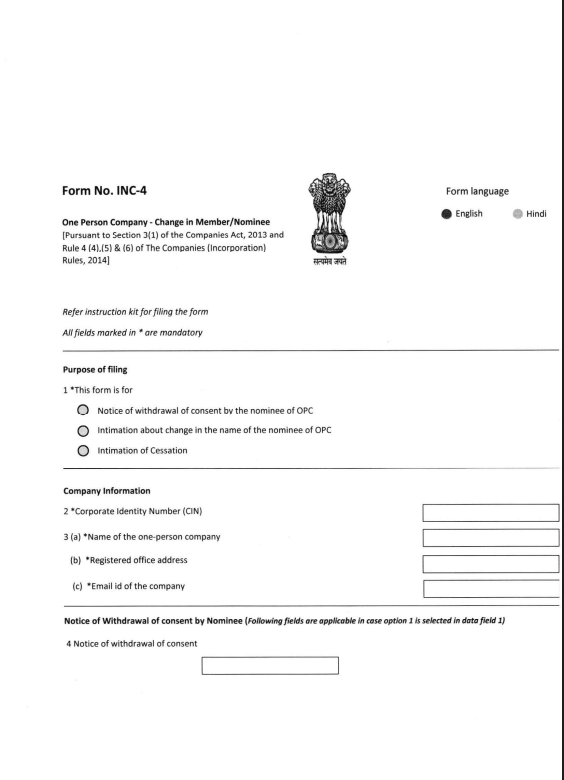
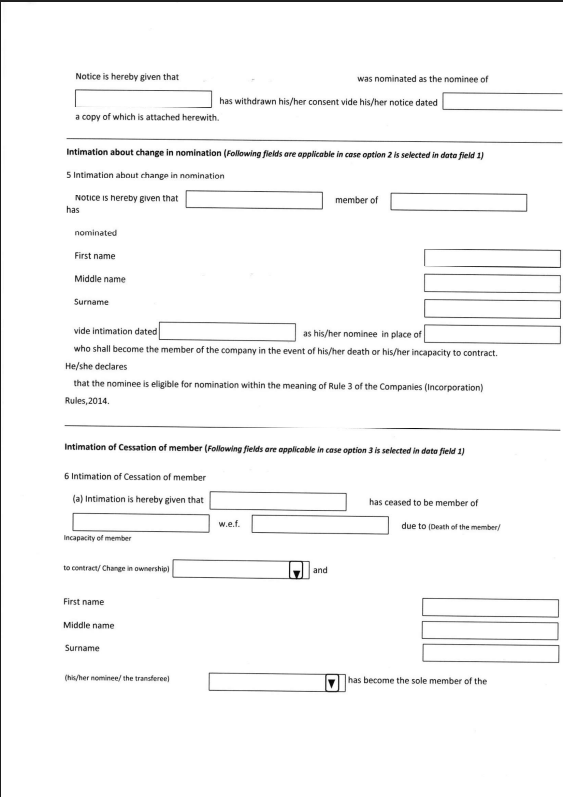
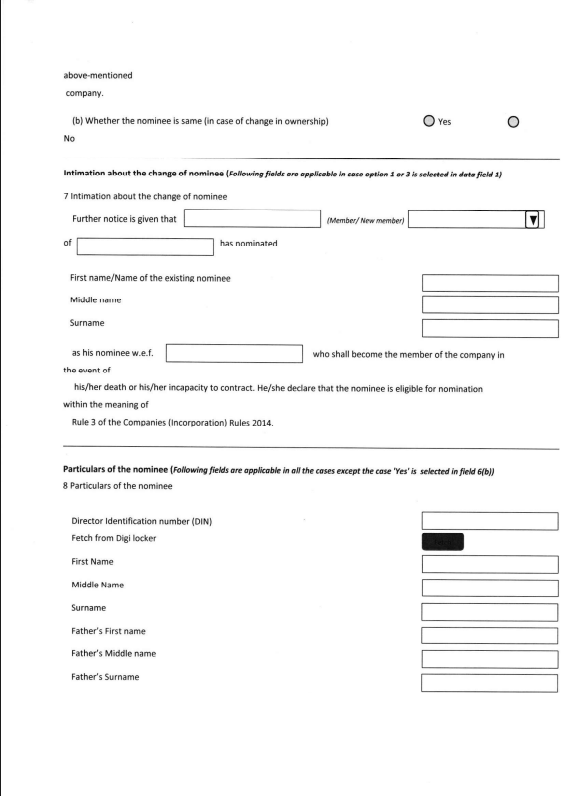
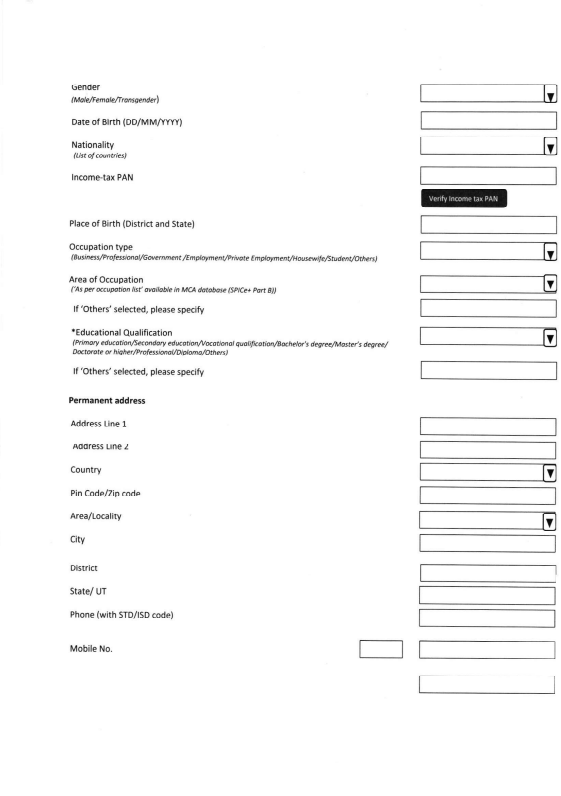
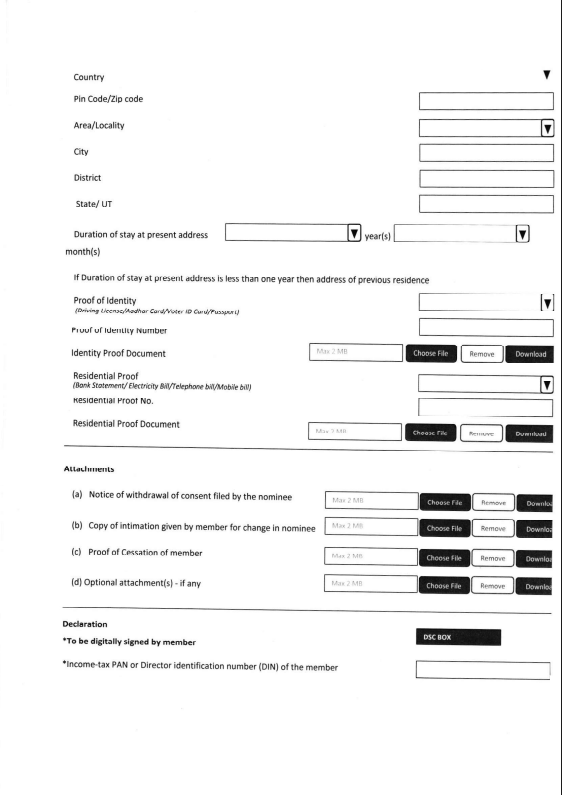
Form INC-4 continues to be an active and valid form under the Companies (Incorporation) Rules, 2014.
It is specifically used by a One Person Company (OPC) to:
Intimate a change of nominee, or
Report withdrawal of consent by the existing nominee.
To Access Form INC 4: https://e-book.icsi.edu/notificationdetail.aspx?acturl=6CoJDC4uKVUR7C9Fl4rZdatyDbeJTqg3uGlpRTblQtxSy/m3U1M6zxiQwLosBZ/x
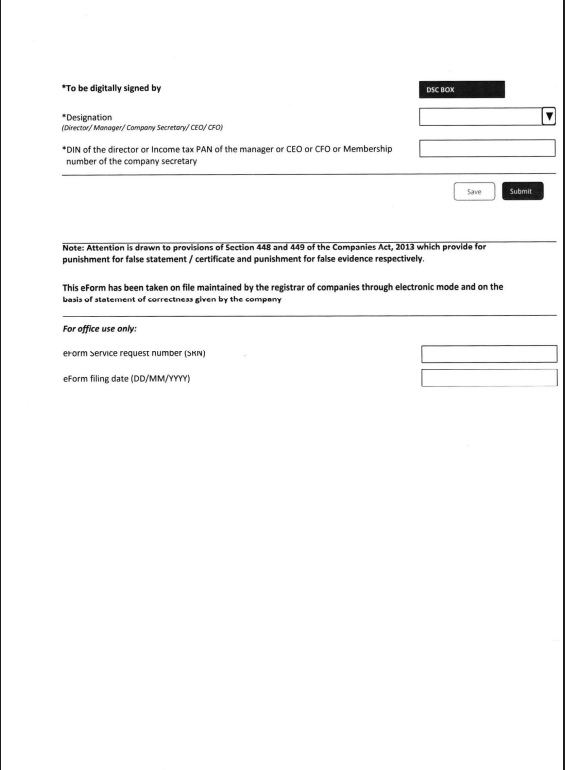
Please note that this form has to be filed online on the MCA Website.
Rule 5. Penalty
If a One Person Company (OPC) or any officer of such company breaks any provision of these rules, they are punishable with a fine up to ₹10,000.
If the violation continues after the first day, an additional fine up to ₹1,000 per day will be charged for the duration of the continuing offence.
Rule 6. One Person Company to convert itself into a public or private company in certain cases
When the paid-up share capital of an OPC exceeds ₹50 lakh or its average annual turnover during the relevant period (three immediately preceding financial years) exceeds ₹2 crore, it must stop functioning as a One Person Company.
The OPC must convert itself within six months of exceeding these limits into either:
A private company with a minimum of two members and two directors, or
A public company with a minimum of seven members and three directors, as per Section 18 of the Companies Act, 2013.
To complete the conversion, the OPC must alter its Memorandum of Association (MOA) and Articles of Association (AOA) by passing a resolution under Section 122(3) of the Act.
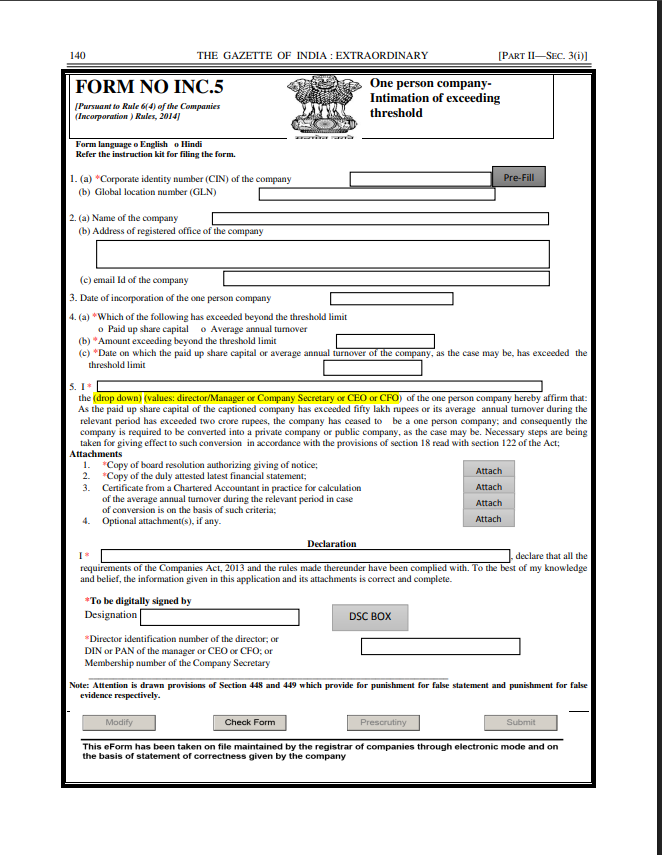
Within 60 days of crossing the limits mentioned in point (1), the company must inform the Registrar in Form INC-5 that it has ceased to be an OPC and is required to convert into a private or public company.
If the OPC or any officer fails to comply with these provisions, the same penalties as Rule 5 apply – fine up to ₹10,000 and ₹1,000 per day for continuing default.
Apart from mandatory conversion, an OPC may also voluntarily convert into a private or public company by:
Increasing the number of members and directors to the minimum required (2 for private, 7 for public),
Meeting the minimum paid-up capital for that company type, and
Following the procedure under Section 18 of the Act.
To access INC Form : https://ca2013.com/wp-content/uploads/2015/07/form-inc-5.pdf
Please note that the form has to be filed online with the MCA.
Rule 7.Conversion of Private Company into One Person Company
1.
A private company, other than a company registered under Section 8 of the Act, can convert itself into a One Person Company (OPC) if it satisfies either of the following financial conditions:
Its paid-up share capital is ₹50 lakhs or less, or
Its average annual turnover during the relevant period (immediately preceding three consecutive financial years) is ₹2 crores or less.
To initiate this process, the company must pass a special resolution in its general meeting, formally approving the proposal to convert into an OPC.
2.
Before passing the special resolution, the company must obtain written No Objection Certificates (NOCs) from all its members and creditors.
This ensures that the conversion will not adversely affect any stakeholder.
The company must secure unanimous consent from members and creditors before proceeding.
3.
After the special resolution is passed, the company must file a copy of the resolution with the Registrar of Companies (ROC) within 30 days of passing it.
The filing must be done using Form MGT-14, as per the provisions of the Companies Act, 2013.
This filing is a statutory requirement to record the company’s intention to change its structure and maintain legal transparency.
4.
Following the filing of the resolution, the company must apply for conversion into a One Person Company through Form INC-6, along with the prescribed fees under the Companies (Registration Offices and Fees) Rules, 2014.
The application must include the following documents:
1. A declaration by the directors, through a sworn affidavit, confirming that:
All members and creditors have given their written consent for conversion.
The company satisfies the financial limits for OPC eligibility (₹50 lakh capital / ₹2 crore turnover).
2. A complete list of members and creditors with their details.
3. The latest audited Balance Sheet and Profit & Loss Account of the company to verify financial standing.
4. A No Objection Certificate (NOC) from secured creditors, if the company has any existing loans or charges.
5.
Once the Registrar of Companies examines the application and is satisfied that all legal and procedural requirements have been fulfilled, he will:
Approve the conversion, and Issue a fresh Certificate of Incorporation reflecting the company’s new status as a One Person Company (OPC).
The company thereafter continues as the same legal entity retaining its existing assets, liabilities, and obligations but with a new corporate structure suitable for single ownership.
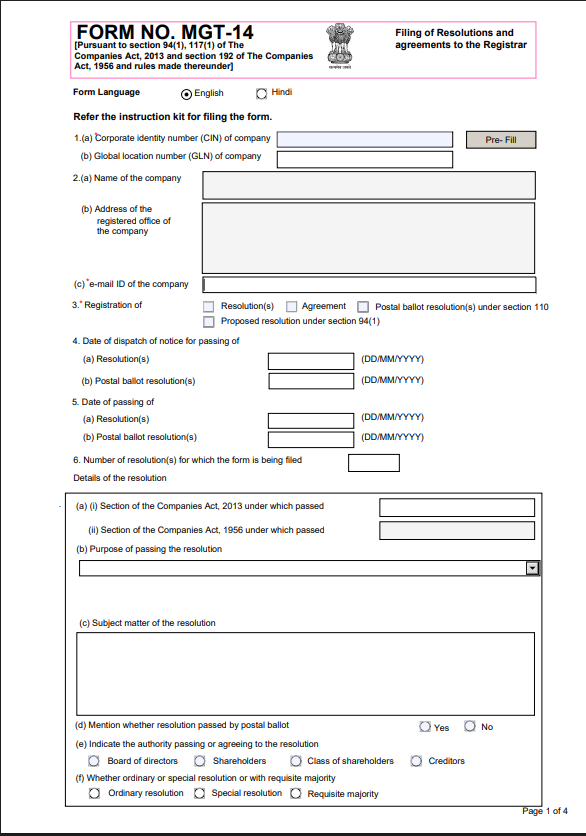
To Access MGT 14: https://ca2013.com/wp-content/uploads/2015/08/Form_MGT-14.pdf
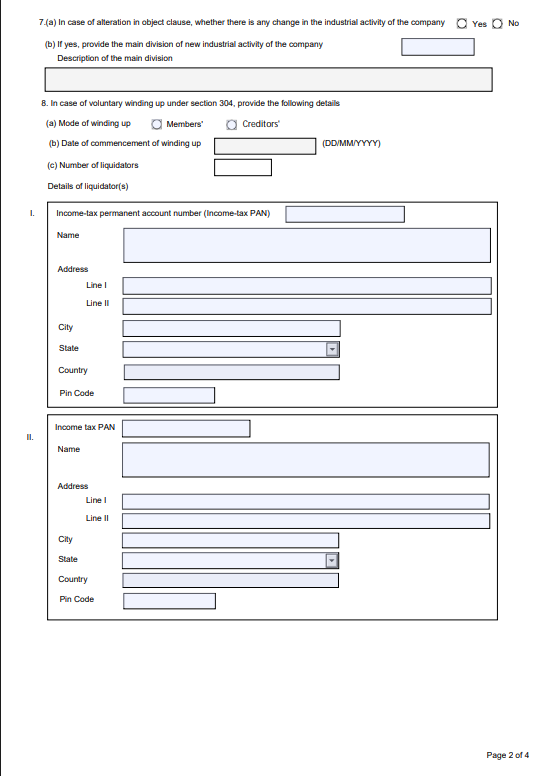
To Access INC 6: https://e-book.icsi.edu/notificationdetail.aspx?acturl=6CoJDC4uKVUR7C9Fl4rZdatyDbeJTqg3LMLNU+J8K+9oCyQgmpxgyqNA5mSY0TuN
Please note that both these forms have to be filed online with the MCA.
Significance of these forms
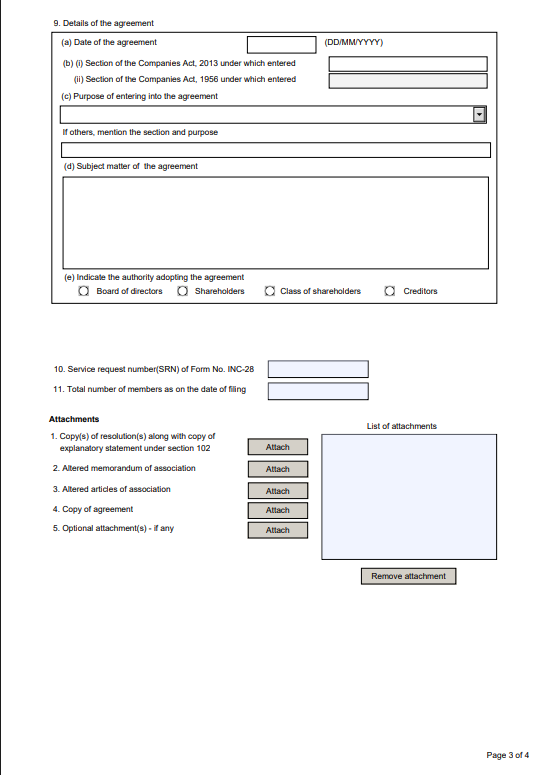
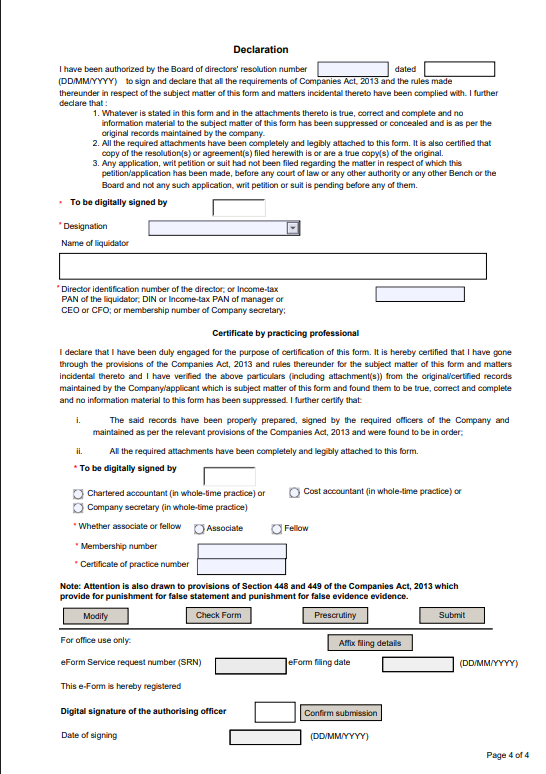
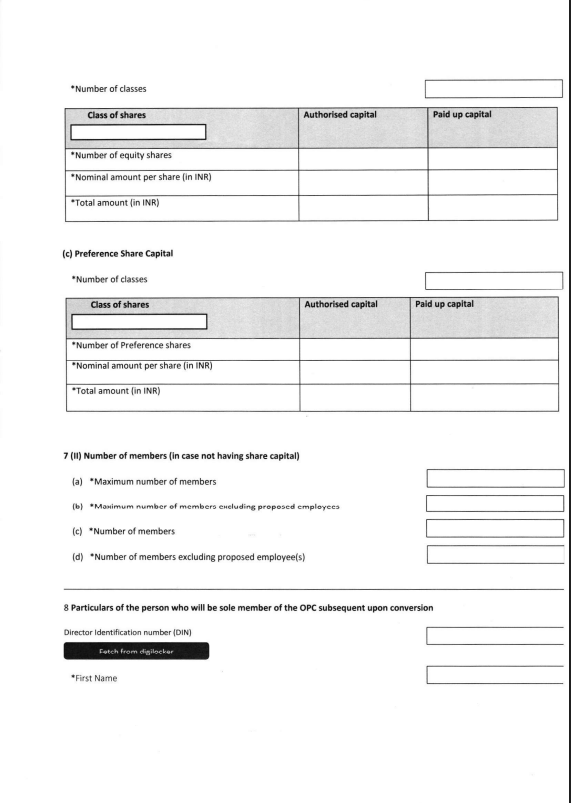
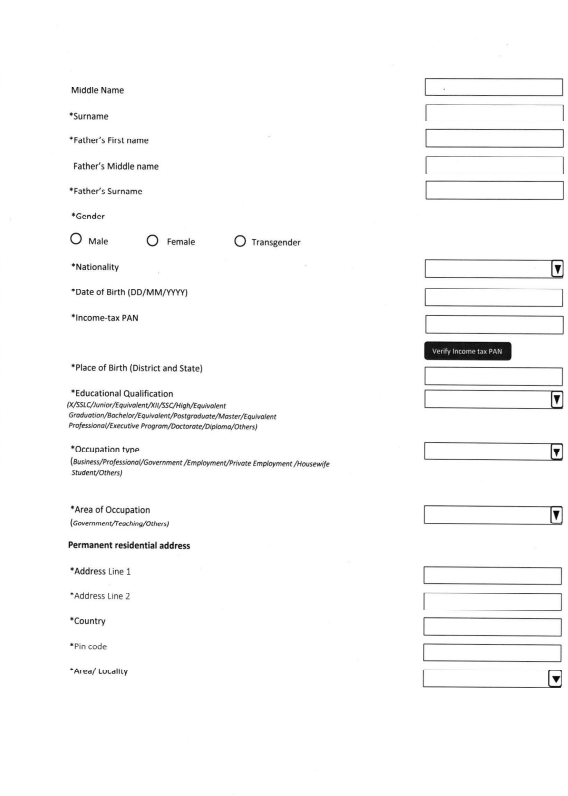
Form MGT-14 is used to file resolutions and agreements passed by a company’s board or shareholders (such as special resolutions) with the Registrar of Companies within the prescribed time.
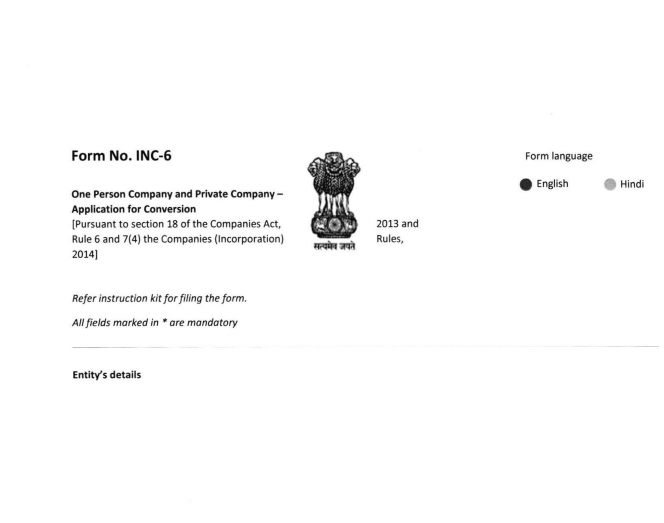
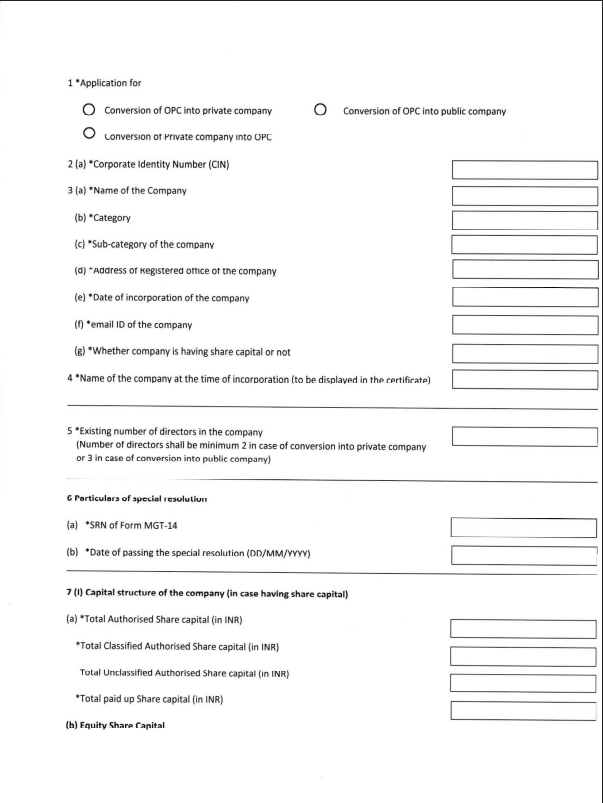
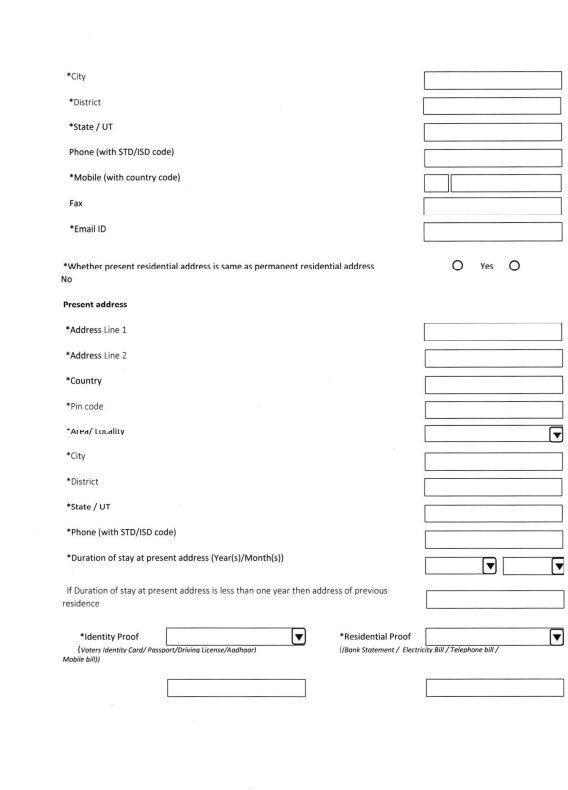
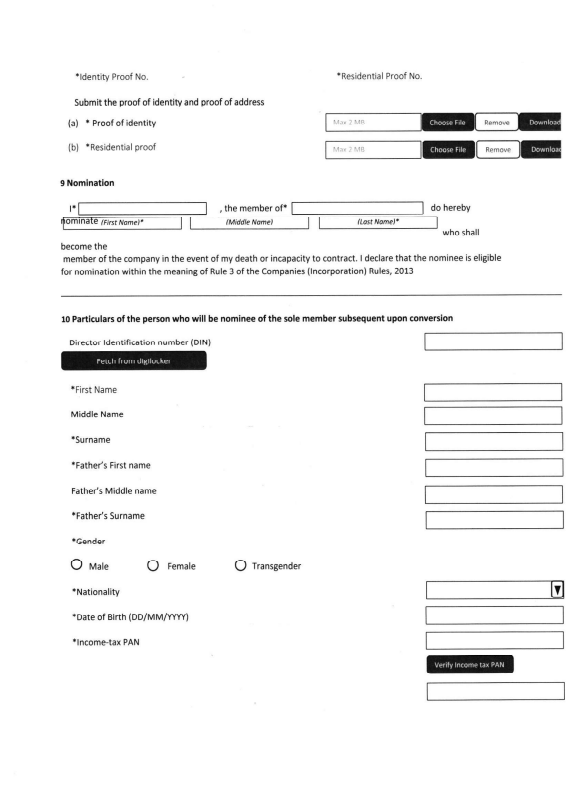
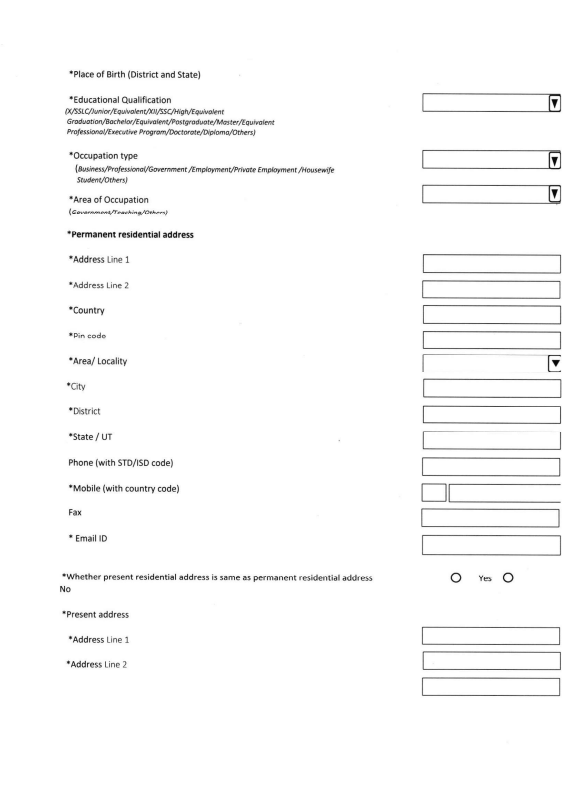
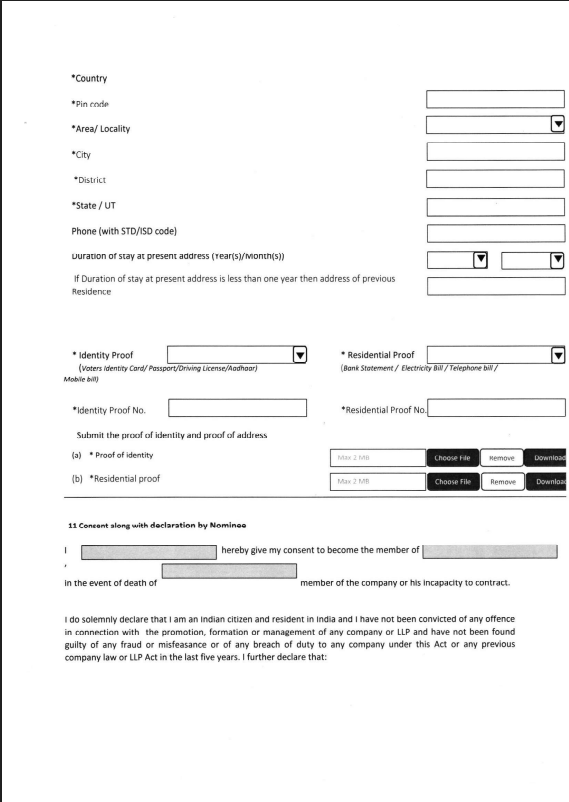
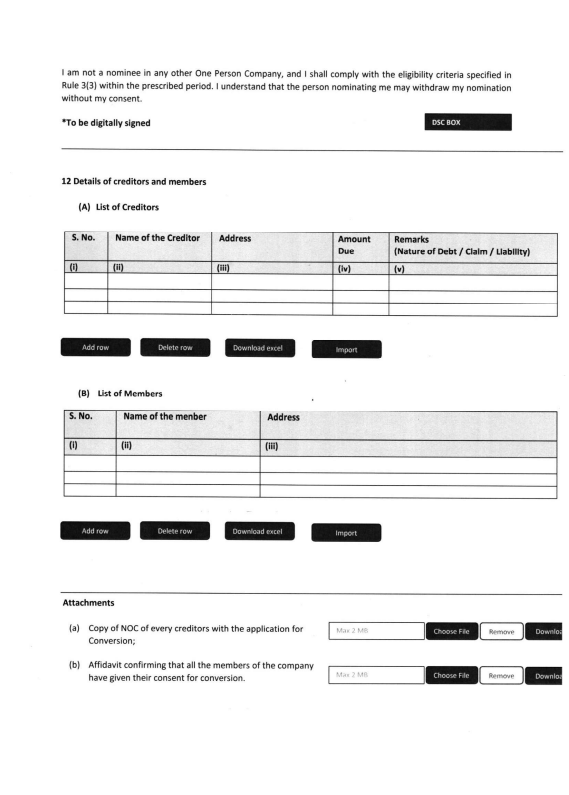
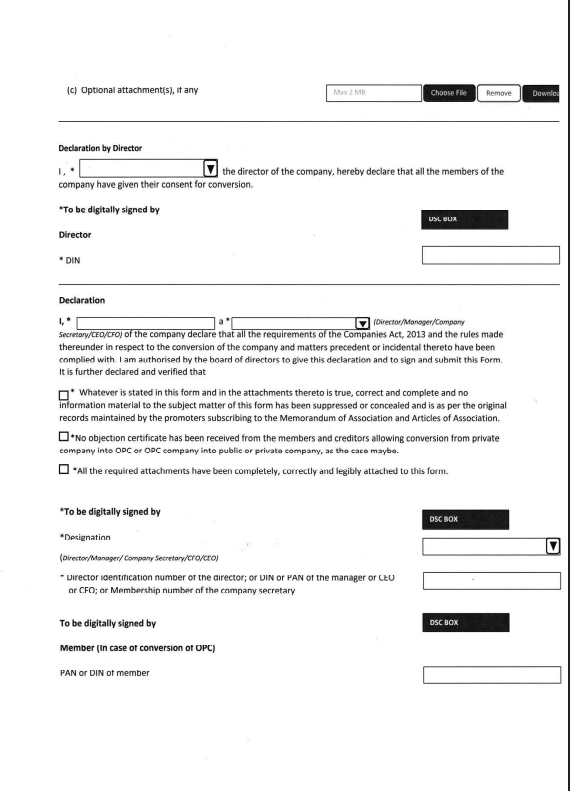
Form INC-6 is used to apply for conversion either from a Private Company to a One Person Company (OPC) or from an OPC to a Private or Public Company along with the required documents and fees.
Form-MGT 14
Form INC-6
Rule 8. Undesirable Names
1.
When checking whether a proposed company name is identical with an existing name, the Registrar will ignore purely formal or stylistic differences so that practically identical names are treated as the same.
The following differences are disregarded:
(a). Words or abbreviations indicating company status. (Private, Pvt, (P), Limited, Ltd, Ltd., LLP, Limited Liability Partnership.)
(b). Words appearing at the end. (Company, Co. , Corporation)
(c). Plural versus singular forms of words.
(d). Letter case, letter type, spacing between letters, and punctuation marks.
(e). Whether words are joined together or separated.
(f). Differences of tense or number.
(g). Phonetic or spelling variations. (P.Q. Industries Limited, P and Q Industries, Pee Que Industries)
Names with numerals are also compared against their word forms (3 & Three would be disregarded).
(h). Misspellings, intentional or otherwise, do not make a name distinct from the correctly spelled equivalent.
(i). Addition of internet designations. (.co , .Com , .NET)
(j). Adding words like New, Modern, Nav, Shri, Sri, Shree, Sree, Om, Jai, Sai, The and similar religious or common prefixes, or the name of a place, does not
make the name acceptable unless the existing company gives a board resolution consenting to such use.(k). Different permutations or combinations of the same words do not make a name distinguishable.
(l). A Hindi or English translation or transliteration of an existing company or LLP name is treated as identical.
2(a).
A proposed name is undesirable if it falls into statutory prohibitions or is offensive or if it violates third party rights:
(i) The name attracts section 3 of the Emblems and Names (Prevention of Improper Use) Act, 1950. (If it uses protected national emblems or names).
(ii) The name includes a registered trade mark or a trade mark subject to an application for registration.
The trademark can be used if the trademark owner or applicant has given written consent and that consent is produced by the promoters.
(iii) The name includes any word or words offensive to any section of the people.
2(b).
Additional situations where a name is undesirable:
(i).
The proposed name is identical with or too nearly resembles the name of a limited liability partnership.
(ii).
The proposed name is not in consonance with the principal objects of the company as set out in the memorandum of association.
Note: A name is not required to state the objects, but if the name suggests particular objects, the memorandum must be consistent with that suggestion.
(iii).
If the company’s main business is financing, leasing, chit fund, investments, securities or similar financial activities, the name must indicate that activity.
(Muthoot Chit Fund)
(iv.)
The proposed name closely resembles a popular or commonly used abbreviated description of an existing company or LLP.
(v).
The proposed name is identical to, or too similar to, the name of a foreign company or foreign LLP that is already incorporated outside India.
The same foreign entity has reserved that name with the Indian Registrar, so the Indian company cannot use it.
Exception:
If a foreign holding company is incorporating a subsidiary in India, the original foreign name may be permitted,
Provided the name includes an addition such as “India”, or the name of an Indian state or Indian city &
the modified name does not conflict with existing names in India and is available.
(vi).
If any part of the name implies a different legal form or constitution than what the company actually is.
This includes words that suggest forms such as: Co-operative, Sehkari, Trust, LLP, Partnership, Society, Proprietor, HUF, Firm etc.
Using such terms creates a misleading impression about the type or structure of the proposed company.
Exception:
The term “Electoral Trust” can be used only by a Section 8 company formed under the Electoral Trust Scheme, 2013.
The company must file an affidavit confirming that this name will be used solely for that specific purpose.
(vii).
The proposed name contains the words British India.
(viii).
The proposed name implies association with or connection to an embassy, consulate or foreign government.
(ix.)
The proposed name includes or implies association, connection or patronage of a national hero or high-ranking or currently serving government
personage.
(x).
The name is vague or is an unexplained abbreviation (e.g., ABC Limited, 23K Limited, DJMO Limited).
The abbreviation is only based on the promoters’ initials, without any meaningful explanation.
Such names are not allowed because they do not convey the business identity clearly.
Exceptions:
An existing company may use its abbreviated form in the name of its subsidiary or JV.
But the new company’s name cannot consist solely of the abbreviation.
Example:
Allowed: Delhi Paper Mills Limited can have a subsidiary company called DPM Papers Limited
Not allowed: DPM Limited (Just the abbreviation is not allowed.)
Well-known companies:
A well-known company may change its own name to an established abbreviation.
(xi).
The proposed name is identical to the name of a company dissolved in liquidation where two years have not elapsed since dissolution.
If the proposed name is identical to a company struck off under Section 248, it will not be allowed for twenty years from the date of striking off publication in the Official Gazette.
(xii).
The proposed name is identical with or too nearly resembles the name of an LLP in liquidation or an LLP struck off within the last five years.
(xiii).
The name contains regulated financial terms such as: Insurance, Bank, Stock Exchange, Venture Capital, Asset Management, Nidhi, Mutual Fund, or any similar expression.
These words imply activities that fall under the supervision of regulators like IRDA, RBI, SEBI, MCA, etc.
If the applicant submits a declaration confirming that all applicable regulatory requirements have been complied with.
Only then can the name containing such regulated terms be considered for approval.
(xiv).
The proposed name includes the word State.
This will be allowed only for a government company.
(xv).
The proposed name contains only the name of a continent, country, state or city (for example Asia Limited, Germany Limited, Haryana Limited, Mysore
Limited) and is therefore too generic.
(xvi).
The name is generic and descriptive only rather than distinct.
(xvii).
The name would create a misleading impression about the scale or scope of activities that the company could not reasonably support given its
resources.
(xviii).
A proposed name cannot include the name of a foreign country or foreign city.
Unless the applicant provides proof of significant business relationship with that country.
This could be in the form of MOU with that country or city etc.
Exception
Combinations like India Japan or Japan India are allowed only when there is government-to-government participation.
Names containing the name of an enemy country are prohibited; the Central Government may declare such countries.
3.
If a company changes its activities but its name does not reflect the new activities, the company must change its name to align with the new activities within six months of the change, and must follow all legal procedures and compliances that apply to a change of name.
4.
If the proposed name uses the name of a person who is not a promoter or a close blood relative of a promoter, the application must include the written no objection of that person.
If the name includes the name of a relative of the promoter, proof of relationship must be attached and the applicant must explain and prove the significance of using coined words derived from promoters’ or relatives’ names.
5.
The applicant must declare yes or no whether it has used the proposed name in the last five years in any other business form.
(Sole proprietorship, Partnership, LLP, unincorporated entity etc.).If the answer is yes, the applicant must give details and produce a No Objection Certificate from other partners or associates for the proposed company or LLP’s use of the name, and state whether the other business will be taken over by the proposed company or LLP.
6.
Certain words and combinations are restricted and cannot be used in any language without prior Central Government approval.
These words and combinations include:
Board, Commission, Authority, Undertaking, National, Union, Central, Federal, Republic.
President, Rashtrapati, Small Scale Industries, Khadi and Village Industries Corporation.
Financial, Forest, Corporation, Municipal, Panchayat, Development Authority.
Prime Minister, Chief Minister, Minister.
Nation, Forest corporation, Development Scheme.
Statute, Statutory, Court, Judiciary, Governor, Bureau.
and use of the word Scheme with government names.
Prior approval is required because these words suggest government authority or statutory status.
7.
For companies formed under section 8, the name should include words that indicate non-profit character such as Foundation, Forum, Association, Federation, Chambers, Confederation, Council, Electoral Trust and similar terms.
Companies incorporated as Nidhi must have the words Nidhi Limited as the last words of their name.
8.
When a company changes its name, the old name is retained in the Registrar’s database and is blocked from use by any other company, including group companies, for three years from the date of the change.
This restriction may be lifted only by a specific direction from a competent authority in the course of compromise, arrangement or amalgamation.
Rule 9. Reservation of Name
An application for the reservation of a company name must be made in Form INC-1.
This application should be submitted along with the prescribed fee as stated in the Companies (Registration Offices and Fees) Rules, 2014.
The purpose of this process is to reserve the proposed name of the company before incorporation, ensuring that no two companies are registered with identical or too similar names.
Note:
Form INC-1, earlier used for company name reservation, has been omitted.
The Name Reservation Process is now done through Part A of the SPICe+ (INC-32) form on the MCA portal.
This integrates both name approval and incorporation in one process.
Rule 9A. Extension of reservation of name in certain cases
(a)
The Registrar may extend the reservation period of a name up to 40 days from the date of approval under Rule 9, if an additional fee of ₹1,000 is paid before the expiry of 20 days from the date of approval.
(b)
The reservation period can be further extended to 60 days from the date of approval, if a fee of ₹2,000 is paid before the expiry of the 40-day period mentioned in clause (a).
(c)
Alternatively, the name reservation can be extended to 60 days from the date of approval by paying a fee of ₹3,000, provided payment is made before the expiry of 20 days from the date of approval.
The Registrar also has the authority to cancel the reserved name if it violates the conditions laid down under Section 4(5) of the Companies Act, 2013.
Rule 10. Where Articles contain entrenchment clauses
1.
If a company’s Articles of Association include entrenchment provisions (which make certain clauses harder to alter), the company must inform the Registrar of Companies (ROC) about such provisions.
2.
At the time of incorporation, this notice must be filed in Form INC-2 (for One Person Companies) or Form INC-7 (for other types of companies), along with the prescribed fee under the Companies (Registration Offices and Fees) Rules, 2014.
3.
For existing companies that introduce entrenchment provisions later, the notice must be filed in Form MGT-14 within 30 days from the date of making such changes, along with the applicable fee.
Note:
Form INC-2 and INC-7 have both been omitted.
Earlier, INC-2 was used to incorporate One Person Companies (OPCs), while INC-7 was used for other company incorporations.
Now, both processes are carried out using the integrated SPICe+ (INC-32) form.
