The Companies (Restriction on Number of Layers)
The Companies (Restriction on Number of Layers) Rules, 2017
The Companies (Restriction on Number of Layers) Rules, 2017 were introduced to regulate the structure of corporate ownership in India by limiting the number of subsidiary layers a company can have.
Important terms to understand:
Subsidiary Company:
A subsidiary company is defined under Section 2(87) of the Companies Act, 2013. It refers to a company in which another company, known as the holding company:
(a). Controls the composition of its Board of Directors.
(b). Exercises or controls more than one-half of its total share capital, either alone or together with its other subsidiaries.
So,
If Company A owns more than 50% of the share capital of Company B.
Has the power to appoint or control the majority of its directors, then:
Company B is a subsidiary of Company A, and Company A is the holding company.
Layer of Subsidiary
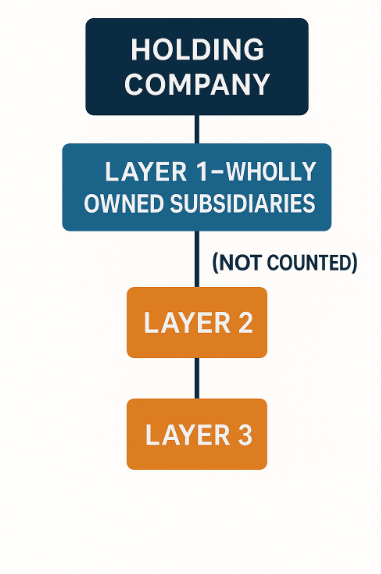
A layer of subsidiary refers to each level in the chain of subsidiary relationships below the holding company.
Each step down in the ownership chain represents one layer of subsidiary.
Rule 2. Restriction on Number of Layers for Certain Classes of Holding Companies
General Restriction
From the date of commencement, no company (other than those exempted) can have more than two layers of subsidiaries.
Exceptions
A company may acquire a foreign company that already has more than two subsidiary layers as per that country’s laws.
Wholly Owned Subsidiaries (WOS): While counting the number of layers, one layer consisting entirely of wholly owned subsidiaries shall not be included.
(2).
Exempted Classes of Companies
The rule does not apply to the following classes of companies:
(a). Banking companies - As defined under Section 5(c) of the Banking Regulation Act, 1949.
(b). Non-Banking Financial Companies (NBFCs) - Registered with the RBI under Section 45-I(f) of the Reserve Bank of India Act, 1934.
(c). Insurance companies - Registered under the Insurance Act, 1938 and regulated by Insurance Regulatory and Development Authority Act, 1999.
(d). Government companies - As defined under Section 2(45) of the Companies Act, 2013.
Section 186(1) of the Companies Act, 2013 restricts companies from making investments through more than two layers of investment subsidiaries.
Exception
If an Indian company acquires a foreign company, that foreign company may have more than two layers of subsidiaries as per the laws of its own country.
The Companies (Restriction on Number of Layers) Rules, 2017 were introduced to enforce and clarify this restriction mentioned in Section 186(1).
(3).
The 2017 Rules are not in derogation of Section 186(1), which means they do not override or contradict that section but both must be read together.
The Act gives the legal restriction, while the Rules explain how it is implemented in practice.
Together, they mean a company can have a maximum of two layers of subsidiaries (excluding one wholly owned layer).
(4).
Companies existing before the commencement of the Rules (20th September 2017) with more than two layers had to:
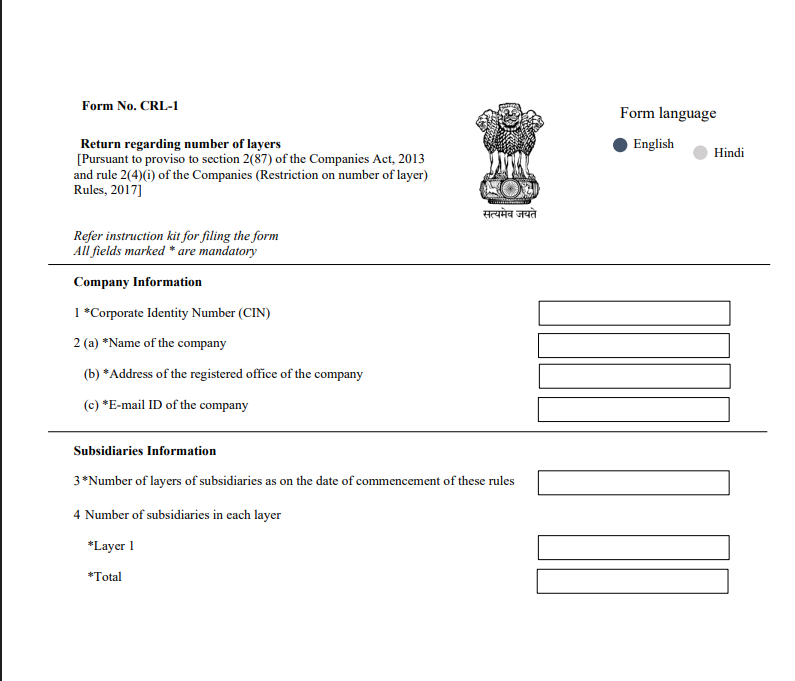
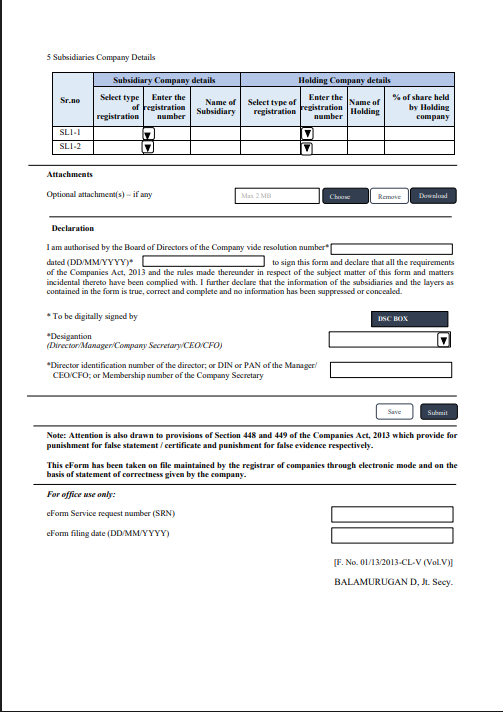
File Form CRL-1 with the Registrar within 150 days of publication, listing all subsidiary details.
Not add any new subsidiary layers after the Rules came into effect.
If a company reduces the number of its subsidiary layers at any point,
It cannot later increase the number of layers beyond:
The reduced number.
The maximum limit of two layers.
Whichever of the two numbers is higher becomes the new upper limit for that company.
The foreign subsidiary exception under Section 186(1) continues to apply and Indian companies can still acquire foreign companies even if those have more than two layers abroad.
(5).
If any company violates these rules:
The company and its officers can be fined up to ₹10,000.
If the violation continues, a daily fine of ₹1,000 may be imposed for each day after the first.
To access Form CRL - 1: https://e-book.icsi.edu/notificationdetail.aspx?acturl=WApIh9eSlBz3BxWGhR6jmZB2QfNpXzjQFCMcVHmTViHQm3i9VrlcKA==
Please note that this form has to be filed online.
Form CRL -1